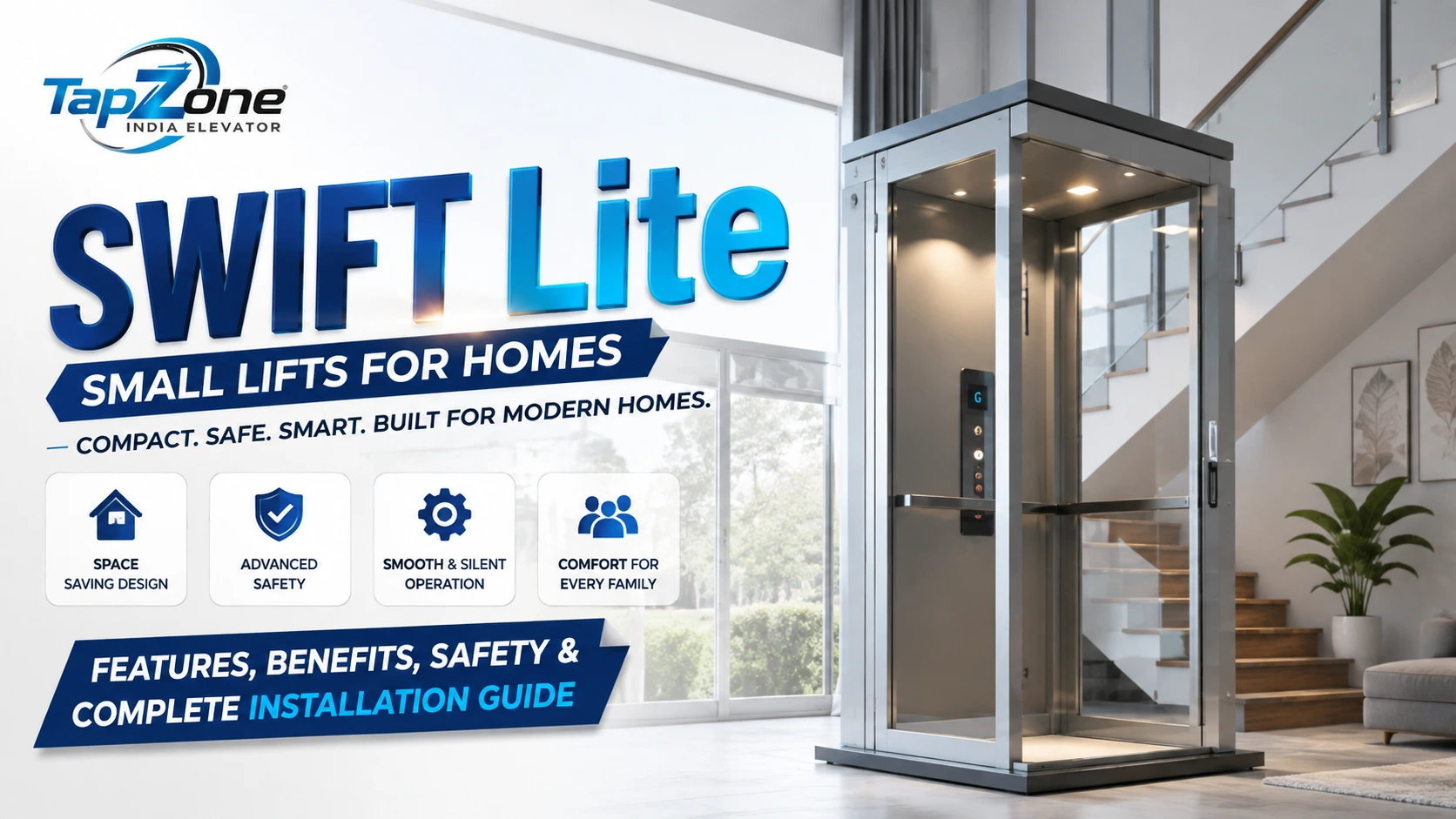
The houses being built today are becoming intelligent, compact, and convenience-driven. As family members try to enhance accessibility from one floor to another in an easy way without doing any significant modifications in their structures, compact elevators for residential buildings have become a viable choice. SWIFT Lite is built with this idea in mind, providing an efficient solution to lift people up and down comfortably, using available space efficiently.
A well-designed small elevator in a house will provide comfort and convenience in moving around for children, seniors, and people with movement difficulties. Unlike traditional elevators, which are usually large in size, the compact elevator for home can be designed taking into consideration the space available and the needs of the residential structure. Thus, a mini elevator in home is ideal for villas, duplexes, bungalows, and multistorey residential structures.
When looking for a small elevator for a residential building, it should not just satisfy the need for aesthetic appearance and compactness. It should be efficient in its functioning, reliable, safe, provide comfortable movement and space efficiency, as well as professional installation services. Tapzone India Elevator has been serving in designing efficient residential elevators.
What Is SWIFT Lite?
SWIFT Lite is a compact lifting concept designed for residences where optimization of space is a key factor. The device is meant to offer easy transport between levels in residences without taking up the space of a regular commercial elevator.
One of the major benefits of having a compact home elevator is that it will enable planning to be done based on the building itself, rather than designing the building for an elevator. Based on the site, the available shaft or installation space, number of floors, load capacity, entrance design, and other technical factors, the final design can be modified.
Mini home elevators are especially useful in places where homeowners want to make their homes more accessible, but there is not enough space for a regular elevator. Likewise, a mini lift for home might be considered in case of independent houses when the need is more for residence than for commercial purposes.
When choosing a small elevator for home use, one should consider the whole system and not just the cabin size. The drive system, landing doors, control system, emergency operation and safety devices, power requirements, maintenance requirements, and installation conditions all affect the performance of the lift.
Why Are Small Home Lifts Becoming Popular?
Residential architecture has changed considerably over the years. Homes are increasingly designed on narrow plots and multiple floors, making vertical space more important. Staircases remain essential, but they can become inconvenient when users need to repeatedly move between floors.
A properly planned small lift for home provides an alternative method of vertical transportation while preserving the functionality of the staircase.
It can be especially beneficial for:
- Senior citizens who find frequent stair climbing difficult
- Families living in multi-storey homes
- People requiring improved mobility
- Homeowners carrying heavy household items
- Villas and duplex residences
- Homes with limited construction space
- Properties where accessibility is a long-term priority
A compact mini lift for home can also improve the long-term usability of a property. Even if every family member can currently use stairs comfortably, accessibility requirements may change with age or lifestyle.
Understanding Small Lift Size for Residential Installation
One of the first questions homeowners ask is about small lift size. There is no single universal dimension that works for every property because residential lift requirements depend on the available installation area, cabin capacity, number of stops, door arrangement, structural configuration, and applicable safety requirements.
The required small lift size should therefore be finalized only after a proper site assessment.
Before deciding the small lift size, the following factors should be evaluated:
- Available floor area
- Proposed cabin dimensions
- Required load capacity
- Number of floors
- Door opening direction
- Shaft or enclosure arrangement
- Machine and control equipment location
- Headroom and pit requirements
- Electrical supply
- Maintenance accessibility
- Structural conditions
A smaller cabin does not automatically mean that the entire elevator installation will occupy the same small footprint. The complete installation area includes structural and technical requirements. Therefore, homeowners should never purchase equipment based only on a cabin measurement.
For a small elevator for home, accurate site measurement is one of the most important steps before manufacturing and installation.
Key Features of SWIFT Lite
1. Compact Residential Design
The primary objective of a compact residential elevator is efficient space utilization. SWIFT Lite can be planned for homes where conventional elevator systems may require more space than the homeowner wants to allocate.
This makes a small lift for home suitable for residential projects where every square foot matters.
2. Space-Efficient Configuration
The lift layout can be considered according to the building’s available area. Depending on the project, the installation may be planned around existing architectural conditions.
This is one reason why a mini lift for home can be an effective option for renovation and new residential projects.
3. Convenient Floor-to-Floor Movement
A home elevator should simplify everyday movement. Whether a user is carrying luggage, groceries, laundry, or other household materials, an appropriately designed lift can reduce dependence on stairs.
A small elevator for home can therefore contribute to convenience as well as accessibility.
4. Residential-Friendly Operation
Home elevators need to operate smoothly without creating unnecessary disturbance in the living environment. Proper engineering, installation, alignment, and maintenance are essential for achieving comfortable operation.
5. Safety-Oriented Engineering
Safety is the most important consideration in any lifting system. Residential elevators should incorporate appropriate safety features and protection systems according to their design and applicable requirements.
6. Modern Control System
A residential elevator can use a dedicated control system for managing movement, landing calls, door operation, and safety-related functions. The exact control configuration depends on the selected model and project requirements.
7. Customizable Appearance
A home lift is not simply a machine; it becomes part of the property’s interior and architecture. Cabin finishes, doors, lighting, control panels, and other visual elements can be selected according to the project.
Benefits of Installing a Small Lift for Home
The most obvious benefit of a small lift for home is convenience, but its advantages extend much further.
Better Accessibility
A residential elevator creates an easier route between floors for users who may have difficulty climbing stairs. This makes it a valuable long-term investment for accessibility.
Efficient Space Utilization
Compared with larger commercial elevator systems, compact residential solutions are intended to minimize unnecessary space requirements.
Improved Daily Convenience
Moving groceries, luggage, cleaning equipment, furniture accessories, and other household items between floors becomes easier with a home elevator.
Long-Term Residential Value
Accessibility features can improve the practical appeal of a multi-storey property. A professionally installed small elevator for home may therefore contribute to the overall functionality of the residence.
Suitable for Multi-Storey Homes
Duplexes, triplexes, villas, and independent houses can benefit from compact vertical transportation solutions when the building structure permits installation.
Supports Aging-in-Place
Homeowners can plan their properties for future accessibility rather than waiting until mobility becomes a challenge.
Mini Lift for Home vs Conventional Elevator
A mini lift for home is generally considered when the primary requirement is residential vertical transportation and space is limited. Conventional elevators, on the other hand, may be designed for higher traffic, larger capacities, commercial environments, or more extensive building requirements.
The right solution depends on:
- Building type
- Number of users
- Required capacity
- Available space
- Number of floors
- Traffic frequency
- Installation conditions
- Budget
- Maintenance requirements
A mini lift for home should therefore not be selected simply because it is smaller. The system must match the actual transportation requirement of the household.
Portable Lift for Home – Is It the Right Choice?
The term portable lift for home is often used by homeowners looking for flexible or less structurally intensive lifting solutions. However, the word “portable” should be understood carefully.
A permanent residential elevator installation typically requires proper planning, anchoring, electrical connections, safety systems, access arrangements, and professional installation. Therefore, homeowners should verify exactly what type of lifting system is being offered when they search for a portable lift for home.
A portable lift for home may be suitable only for specific applications depending on its design, load capacity, travel height, installation method, and safety certification. It should never be treated as a simple movable appliance.
Before selecting a portable lift for home, discuss the following with the manufacturer:
- Maximum load
- Travel height
- Installation requirements
- Power requirements
- Safety systems
- Emergency operation
- Maintenance procedure
- Warranty
- Intended residential application
Complete Installation Guide for SWIFT Lite
Installing a residential elevator requires more than simply placing the equipment inside a house. A professional installation normally follows a systematic process.
Step 1: Site Inspection
The first stage is a detailed inspection of the property. The installation team evaluates floor-to-floor height, available space, structural conditions, access points, electrical supply, and possible lift location.
This step is essential for determining the appropriate small lift size.
Step 2: Requirement Assessment
The homeowner’s requirements are discussed, including:
- Number of floors
- Expected users
- Load requirement
- Cabin preference
- Door configuration
- Usage frequency
- Interior design preferences
- Available installation area
Step 3: Lift Planning
After collecting site information, the elevator layout is developed. The proposed small lift size and installation configuration should be finalized based on actual measurements rather than assumptions.
Step 4: Civil and Structural Preparation
Depending on the selected system, certain civil or structural preparations may be required. These can include creating a shaft or enclosure, preparing landing openings, arranging suitable support structures, and providing necessary access.
The exact requirements depend on the elevator design and property.
Step 5: Equipment Installation
The elevator components are installed according to the manufacturer’s engineering requirements. Mechanical components, cabin structures, guide systems, doors, controls, and associated equipment must be properly aligned.
Step 6: Electrical Connection
The required electrical connections and control systems are installed by qualified professionals. Proper earthing, protection, and power arrangements are important for reliable operation.
Step 7: Safety Testing
Before the elevator is handed over, safety functions and operational performance should be checked. Door operation, controls, emergency systems, movement, stopping, and other applicable safety features should be tested.
Step 8: Final Commissioning
After successful testing, the system is commissioned for operation. The homeowner should receive appropriate operating and maintenance guidance.
Safety Features to Look for in a Small Home Lift
Safety should always be prioritized over appearance or price when selecting a small lift for home.
Important safety considerations can include:
- Emergency stop functionality
- Door safety mechanisms
- Overload protection
- Emergency lowering or rescue arrangement
- Safety brakes or equivalent protective mechanisms
- Reliable landing controls
- Proper electrical protection
- Emergency communication provisions where applicable
- Controlled acceleration and deceleration
- Professional installation and inspection
The exact safety configuration depends on the elevator design. Homeowners should ask the manufacturer to explain every safety system before installation.
A small elevator for home should never be purchased only by comparing cabin size and price. The complete safety architecture matters far more.
How to Choose the Right Small Lift Size?
Choosing the correct small lift size requires balancing space availability with actual user requirements.
A cabin that is too small may become uncomfortable, while an unnecessarily large cabin may consume valuable residential space.
Consider:
Number of Users: Determine how many people normally need to use the elevator together.
Mobility Requirements: If the lift is intended for users with mobility equipment, additional cabin space may be necessary.
Material Movement: If the lift will regularly transport groceries, luggage, or household items, capacity and cabin dimensions should reflect that use.
Building Space: Measure the available area carefully before finalizing the design.
Door Configuration: Door placement can significantly influence the overall layout.
For these reasons, there is no single “best” small lift size for every house.
Maintenance Requirements
Even a compact home elevator requires regular maintenance. Preventive servicing helps identify wear, alignment issues, electrical problems, unusual sounds, or other operational concerns before they become major failures.
A basic maintenance program may include:
- Checking doors and interlocks
- Inspecting control systems
- Checking electrical connections
- Examining mechanical components
- Checking lubrication requirements
- Testing emergency systems
- Inspecting guide and movement components
- Cleaning the cabin and equipment areas
- Reviewing unusual vibration or noise
- Maintaining service records
Regular professional servicing helps extend equipment life and supports dependable operation.
Small Lift for Home: Cost Factors
The cost of a small lift for home depends on several variables rather than only the cabin size.
Important cost factors include:
- Lift capacity
- Number of floors
- Travel height
- Cabin dimensions
- Door type
- Drive technology
- Structural requirements
- Civil work
- Electrical work
- Interior finishes
- Safety equipment
- Installation complexity
- Customization
- Maintenance requirements
A mini lift for home may appear economical initially, but homeowners should compare the complete project cost, including installation and required structural work.
Similarly, when comparing a portable lift for home with a permanent elevator, the homeowner should evaluate suitability, safety, durability, service availability, and long-term operating requirements rather than focusing only on purchase price.
Why Choose Tapzone India Elevator?
Proper selection of the manufacturer and installer is equally critical as that of the elevator model. Tapzone India Elevator specializes in elevators specifically meant for residence, taking into consideration such aspects as accessibility, space optimization, safety, and user convenience.
For those home owners who are contemplating the installation of an elevator in home but are confused, proper consultation can give them some directions in terms of configuration of the building.
The ideal solution must be based upon site requirements and not just product specifications. This whole process becomes systematic and transparent through the assistance of the elevator manufacturer.
When evaluating a small elevator for home, homeowners should look for:
- Professional technical consultation
- Proper site inspection
- Quality engineering
- Appropriate safety systems
- Installation expertise
- Transparent specifications
- After-sales support
- Preventive maintenance
- Spare-part availability
- Long-term service assistance
Applications of SWIFT Lite
A compact residential elevator can be considered for several types of properties, including:
- Independent houses
- Duplex homes
- Triplex residences
- Luxury villas
- Residential bungalows
- Multi-storey private homes
- Renovated houses
- Compact urban residences
- Senior-friendly homes
- Accessibility-focused residences
The suitability of a mini lift for home depends on the property’s structural and technical conditions.
Frequently Asked Questions
1. What is a small lift for home?
A small lift for home is a compact residential elevator designed to provide convenient movement between floors while making efficient use of available building space.
2. What is the ideal small lift size?
There is no universal small lift size. The correct dimensions depend on available space, required capacity, cabin requirements, door arrangement, structural conditions, and the number of users.
3. Is a mini lift for home suitable for a duplex?
Yes, a mini lift for home can be considered for duplex residences when the building structure, space, load requirement, and installation conditions are suitable.
4. Is a small elevator for home safe?
A professionally designed and installed small elevator for home can incorporate multiple safety systems. Homeowners should verify the safety features, installation quality, testing procedure, and applicable requirements before purchase.
5. Can a small lift be installed in an existing house?
In many cases, a small lift for home can be planned for an existing property, but feasibility depends on available space, structure, access, electrical requirements, and the selected elevator configuration.
6. Is a portable lift for home actually portable?
The term portable lift for home can describe different types of equipment. Homeowners should verify the actual installation method, travel height, load capacity, safety systems, and intended application before selecting one.
7. How is small lift size determined?
The small lift size is determined after considering cabin requirements, load capacity, available shaft or installation area, door configuration, travel height, and technical requirements.
8. Who should install a home elevator?
A small elevator for home should be installed by qualified professionals familiar with residential elevator systems, structural requirements, electrical connections, safety testing, and commissioning.
9. Does a mini lift for home require maintenance?
Yes. Like any mechanical and electrical lifting system, a mini lift for home requires periodic inspection and preventive maintenance to support safe and reliable operation.
10. How can I choose the right residential lift?
Start with a professional site inspection. Discuss your required capacity, number of floors, available space, intended users, design preferences, and budget. This allows the appropriate small lift for home configuration to be selected.
Final Thoughts
It is important to see your home elevator purchase as an investment towards improved accessibility, convenience, and functionality of your home instead of a mere luxury. The properly selected small elevator at home will add convenience and allow making the best use of your space.
While deciding on a home lift, compact small lift or even a portable lift at home, you have to take into consideration such factors as safety and technical feasibility, installation needs, maintenance services and most importantly, personal needs.
The right small elevator size has to be determined on the basis of professional home surveying rather than standard sizes offered online. It goes without saying that the best small home elevator will suit your building and personal needs.
If properly planned, professionally installed, maintained and with safety features in place, then SWIFT Lite can become a viable component of any contemporary multi-storied building. Tapzone India Elevator can assist homeowners in determining their home elevating needs and choosing an elevator suited to their particular conditions.
When searching for a compact elevator for home use, the aim should not be just finding the most compact elevator available, but rather to find the one that suits home elevating needs.