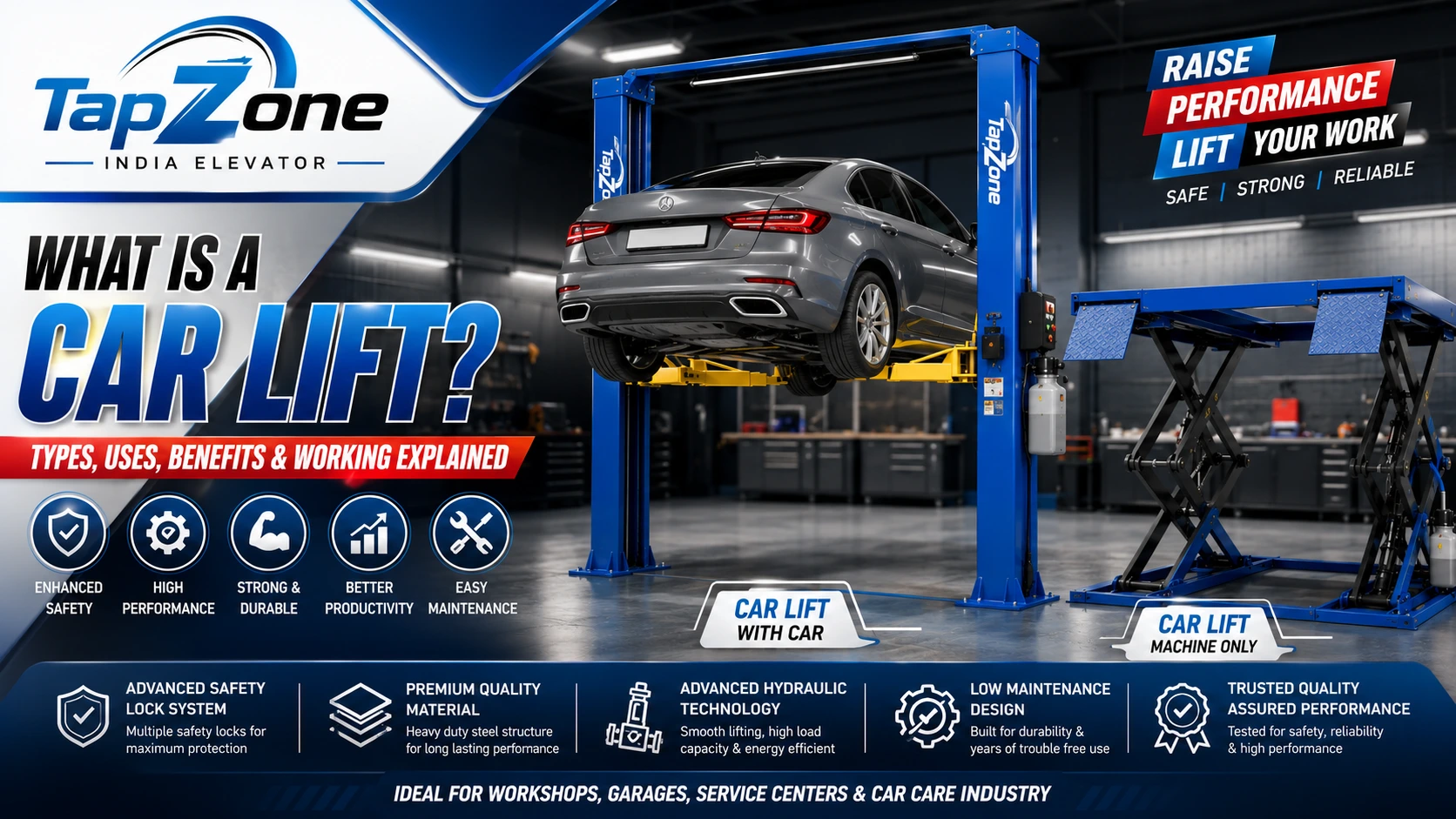
A car lift is probably one of the most important tools that is used in automotive workshops, service stations, parking areas, car showrooms, and industrial garages. Whatever you may be- whether a professional mechanic, a car manufacturer, or a garage owner- purchasing a proper tooling solution for your work becomes very important.
We, at Tapzone India Elevator, offer you some of the best and most efficient car lifting solutions that have been engineered and fabricated to provide optimum performance as per today’s demands of the automotive industry. Our products have been engineered using only the highest grade materials.
In case you ever felt curious about what lifts a car, what do mechanics use to lift cars and what are the three types of automotive lifts, then here’s all the answers to your questions.
Car Lift Meaning
Car lift meaning involves a mechanical device or system that is meant to lift an automobile above the ground level, allowing for inspection, repair, service, detail work, and storage.
The terms like carlift meaning are often searched by many, and it essentially means the same device that is used for lifting cars. The modern car lift uses hydraulics, screws, motors, and electrohydraulic systems for lifting vehicles.
Unlike regular vehicle jacks, the car lifts offer increased stability and lifting capability and even full underbody access.
What is a Car Lift?
A car lift is a heavy-duty machine that elevates vehicles vertically using hydraulic, electro-hydraulic, or mechanical systems. It allows technicians to inspect and repair different parts of the vehicle comfortably without crawling underneath.
Car lifts are available in various lifting capacities ranging from small passenger vehicles to heavy SUVs, commercial vehicles, and luxury automobiles.
Today’s automotive workshops depend on advanced lifting equipment because they improve repair accuracy while significantly reducing manual effort.
What Lifts a Car?
One of the most common questions is what lifts a car?
The answer depends on the lifting mechanism used inside the machine.
Most modern car lifts use:
- Hydraulic cylinders
- Electric motors
- Electro-hydraulic power units
- Mechanical screw systems
- Chain synchronization systems
- Steel lifting arms
- Safety locking devices
- Heavy-duty columns
The hydraulic system converts fluid pressure into lifting force, allowing even heavy vehicles to be raised smoothly with minimal effort.
What Do Mechanics Use to Lift Cars?
People often ask what do mechanics use to lift cars.
Professional mechanics use specialized automotive lifting equipment rather than ordinary vehicle jacks.
Some commonly used equipment includes:
- Two Post Car Lift
- Four Post Car Lift
- Scissor Lift
- Portable Car Lift
- Alignment Lift
- In-Ground Lift
- Mobile Column Lift
- Hydraulic Car Lift
These lifting systems provide better safety, improved accessibility, and faster repair operations.
What Are the Three Main Types of Automotive Lifts?
If you’re wondering what are the three main types of automotive lifts, the answer is:
1. Two Post Car Lift
This is the most popular lift used in automobile workshops.
Ideal for:
- Vehicle repairs
- Brake service
- Suspension work
- Engine repairs
- Transmission maintenance
Advantages
- Full underbody access
- Less floor space required
- Cost-effective
- Fast lifting operation
2. Four Post Car Lift
Four-post lifts provide exceptional stability and are widely used for heavier vehicles.
Suitable for:
- Wheel alignment
- Commercial vehicles
- Long-term vehicle storage
- SUVs
- Luxury vehicles
Advantages
- Higher lifting capacity
- Excellent stability
- Minimal vehicle movement
- Easier loading
3. Scissor Car Lift
Scissor lifts operate using a crossed support mechanism that raises the platform vertically.
Ideal for:
- Tire replacement
- Car detailing
- Small workshops
- Inspection centers
Advantages
- Space-saving design
- Compact installation
- Easy maintenance
- Smooth lifting
Different Types of Vehicle Lifts
There are numerous types of vehicle lifts available depending on workshop size and application.
Hydraulic Car Lift
Uses hydraulic cylinders for smooth lifting.
Perfect for:
- Repair workshops
- Automobile service stations
- Garages
Electro-Hydraulic Lift
Combines electrical power with hydraulic pressure for high efficiency.
Benefits include:
- Faster lifting
- Lower maintenance
- Better energy efficiency
Portable Car Lift
Ideal for:
- Mobile garages
- Small workshops
- Home garages
In-Ground Lift
Installed below floor level.
Commonly used in:
- Luxury workshops
- High-end service centers
- Vehicle showrooms
Alignment Lift
Specially designed for wheel alignment operations.
Includes:
- Turntables
- Slip plates
- Precision leveling
Mobile Column Lift
Suitable for:
- Trucks
- Buses
- Commercial fleets
- Heavy-duty vehicles
How Does a Car Lift Work?
A professional car lift works through a synchronized lifting mechanism.
Step 1
The vehicle is positioned correctly on lifting arms or platforms.
Step 2
The operator activates the control panel.
Step 3
The electric motor powers the hydraulic pump.
Step 4
Hydraulic oil creates pressure inside the cylinder.
Step 5
The piston extends upward.
Step 6
The lifting arms rise evenly.
Step 7
Automatic safety locks engage at multiple heights.
Step 8
The mechanic safely performs inspection or repairs.
Step 9
After work completion, the safety locks disengage.
Step 10
The hydraulic pressure releases slowly, lowering the vehicle smoothly.
Major Components of a Car Lift
A premium-quality lifting system consists of:
- Hydraulic power pack
- Electric motor
- Steel columns
- Heavy-duty lifting arms
- Hydraulic cylinders
- Safety locking system
- Equalizer cables
- Control panel
- Base frame
- Anchor bolts
- Rubber lifting pads
- High-pressure hoses
- Mechanical safety lock
- Limit switches
- Anti-fall protection system
Technical Specification Table
| Specification | Details |
|---|---|
| Product Name | Hydraulic Car Lift |
| Lifting Capacity | 3 Ton to 6 Ton (Customizable) |
| Lift Type | Two Post, Four Post, Scissor, Hydraulic |
| Lifting Height | Up to 1800–2200 mm |
| Minimum Height | 90–120 mm |
| Drive System | Electro-Hydraulic |
| Motor Power | 2.2 kW – 4 kW |
| Operating Voltage | 220V / 380V / 415V |
| Hydraulic Pressure | High-Pressure Industrial Grade |
| Platform Material | Heavy-Duty Structural Steel |
| Safety System | Automatic Mechanical Lock with Anti-Fall Protection |
| Surface Finish | Powder Coated Corrosion Resistant Finish |
| Lifting Speed | Approx. 45–60 Seconds |
| Control System | Push Button / Digital Control Panel |
| Applications | Garages, Workshops, Service Centers, Parking Systems, Automobile Industries |
Applications of Car Lift
Modern lifting systems are widely used in:
- Automobile service centers
- Multi-brand workshops
- Car dealerships
- Luxury vehicle garages
- Parking buildings
- Vehicle manufacturing plants
- Fleet maintenance centers
- Bus depots
- Truck workshops
- EV service stations
- Automobile training institutes
- Industrial maintenance facilities
Benefits of Using a Car Lift
Improved Safety
Professional safety locks minimize accident risks.
Faster Vehicle Servicing
Technicians complete repair work much quicker.
Better Accessibility
Complete underbody inspection becomes easy.
Reduced Physical Effort
Mechanics no longer need to work in uncomfortable positions.
Higher Workshop Productivity
More vehicles can be serviced every day.
Long Service Life
Industrial-grade materials ensure years of reliable operation.
Low Maintenance
Modern hydraulic systems require minimal maintenance.
Excellent Load Stability
Vehicles remain balanced during lifting.
Better Customer Satisfaction
Faster service leads to happier customers.
Space Optimization
Certain lift models maximize workshop floor utilization.
Why Choose Tapzone India Elevator?
At Tapzone India Elevator, we pride ourselves on offering the best automotive lifting services through our innovative and durable lifts. We manufacture all our lifts using the best engineering practices to ensure that the lifts are safe to use and have excellent load capacity. Our lifts can be adapted according to the needs of the customers, depending on whether they require a small garage lift or a large one.
Our Strengths
- Premium-grade raw materials
- Advanced manufacturing technology
- Heavy-duty construction
- Precision engineering
- High lifting accuracy
- Multiple safety locking systems
- Corrosion-resistant finish
- Energy-efficient operation
- Custom-built solutions
- Easy installation
- Reliable after-sales support
- Competitive pricing
- Nationwide delivery
- Experienced technical team
- Quality-tested products
Maintenance Tips for Long-Lasting Performance
To ensure the best performance from your car lift:
- Inspect hydraulic oil levels regularly.
- Check lifting arms for wear and alignment.
- Lubricate moving parts as recommended.
- Test safety locking mechanisms before operation.
- Tighten anchor bolts periodically.
- Clean the lift to prevent dust buildup.
- Replace damaged hydraulic hoses immediately.
- Avoid exceeding the rated lifting capacity.
- Schedule professional servicing at regular intervals.
- Train operators on safe lifting procedures.
Frequently Asked Questions (FAQs)
1. What is a car lift?
A car lift is a hydraulic or electro-hydraulic machine used to raise vehicles safely for repairs, maintenance, inspections, and parking applications.
2. What are the three main types of automotive lifts?
The three most common automotive lifts are Two Post Lifts, Four Post Lifts, and Scissor Lifts, each designed for different workshop requirements.
3. What lifts a car in a professional workshop?
Professional workshops use hydraulic or electro-hydraulic car lifts equipped with heavy-duty steel structures and advanced safety locking systems.
4. What do mechanics use to lift cars?
Mechanics typically use two-post lifts, four-post lifts, scissor lifts, hydraulic lifts, and alignment lifts to safely elevate vehicles during servicing.
5. Which car lift is best for a small workshop?
A two-post hydraulic lift is often the best choice for small workshops because it provides excellent underbody access while occupying less floor space.
6. Are hydraulic car lifts safe?
Yes. High-quality hydraulic car lifts are designed with automatic locking mechanisms, overload protection, anti-fall systems, and robust structural components to ensure maximum safety.
Conclusion
In essence, a car lift is much more than simply equipment because it serves as an investment that ensures safety, increased repair speed, and professional customer service. Car lift meaning, carlift meaning, what lifts a car, what do mechanics use to lift cars, what are the three main types of automatic lifts and the various types of vehicle lifts are some important concepts that need understanding to make the right choice for one’s needs.
The experts at Tapzone India Elevator are proud of offering quality, highly efficient, and reliable car lift products which are built to last. No matter how big or small your workshop or automotive service station is, our lifting equipment can help you grow and become more efficient in your work and give confidence in the work you have done on every single car that comes to you.