As enterprises expand, one difficulty that cannot be ignored is the safe and efficient transport of bulky objects from one floor to another. Manual lifting of goods, whether for a warehouse with cartons, a manufacturing firm with raw materials, a shopping center with inventory, or hospitals with their equipment, is wasteful, costly, and risky.
It is at this point that a goods lift plays a crucial role in any infrastructure today. A properly installed goods lift does not just increase efficiency but also ensures the safety of employees, prevents material loss, and maintains the seamless functioning of the facility. In contrast to conventional passenger elevators, goods elevators are made for the specific purpose of carrying heavy cargo.
Our vision at TapZone India Elevator is that the correct selection of your lifting solution not only depends on the capacity, but it also enhances the overall efficiency of your operation, ensures a safe work environment, and prepares your business for the future. If you are looking for a goods lift, industrial goods lift, commercial goods lift, or heavy-duty goods hoist, then understanding these machines will enable you to choose wisely.
In this guide, you will learn everything you need to know about the various types of goods lifts along with their working, benefits, application in industries, and how you can buy them safely. By the end of this article, you will have all the answers.
Why Goods Lifts Are Becoming Essential in Modern Industries
Modern industries work in an extremely competitive setting where every second counts. Industries cannot afford any delays that might be experienced through manual handling of materials. Heavier loads must be handled with speed and safety all day long.
A modern goods lift saves on physical effort and improves efficiency in the work process. It enables factories, warehouses, shopping complexes, hotels, hospitals, and logistics firms to handle goods vertically without experiencing any delay.
Some major reasons why businesses are increasingly investing in goods lifts include:
- Faster movement of heavy materials
- Improved employee safety
- Reduced labor dependency
- Lower product damage during transportation
- Better space utilization
- Increased operational efficiency
- Long-term cost savings
- Compliance with workplace safety standards
As industries continue to automate their operations, installing a high-quality goods elevator has become a necessity rather than a luxury.
What Is a Goods Lift?
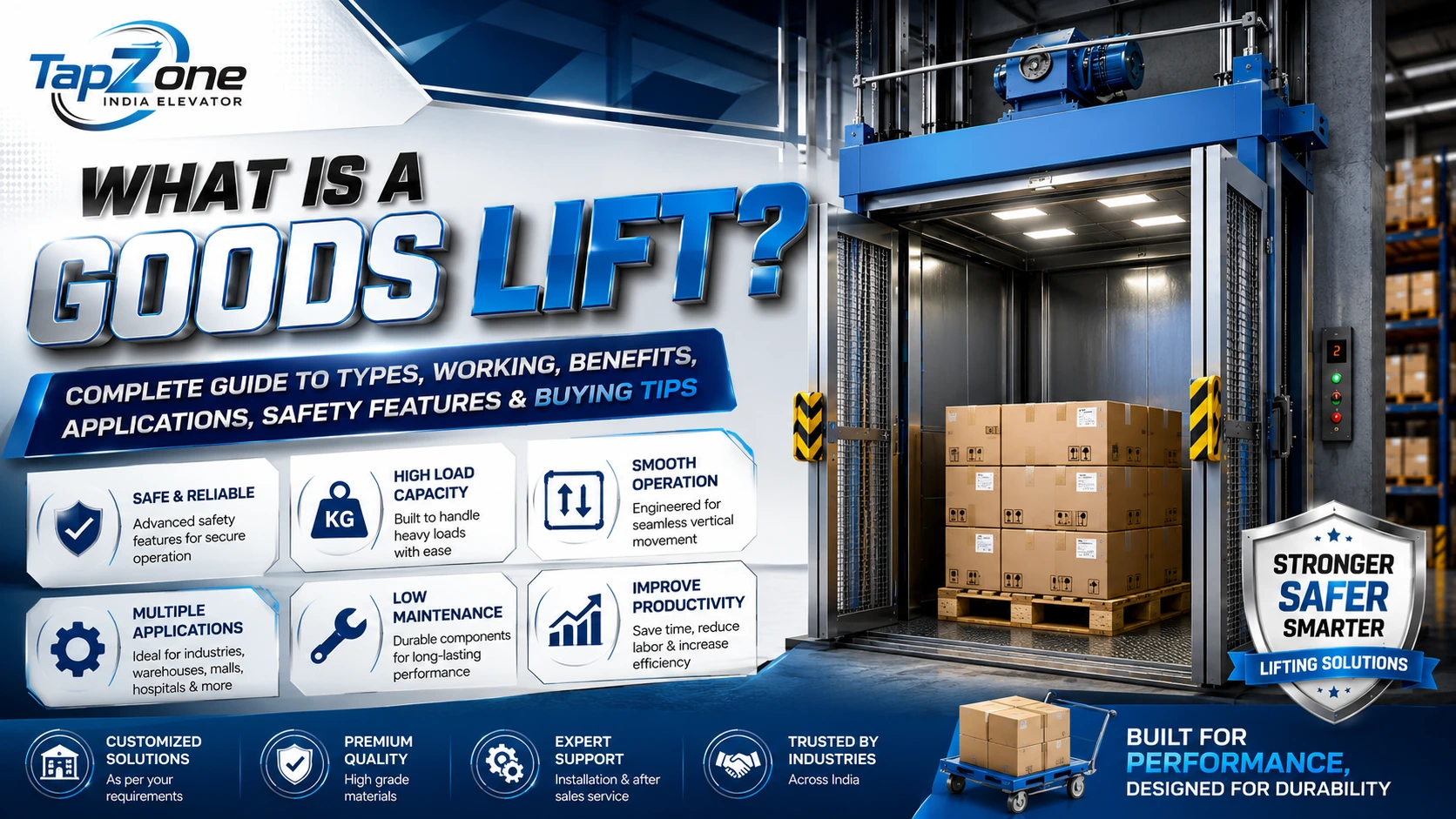
A goods lift refers to an engineering design of a vertical lift intended for transporting heavy cargo such as raw materials, goods, machinery, crates, pallets, and industrial machinery up and down the building’s floors.
In contrast to passenger elevators, they come in a design equipped with robust floors and structural components and have lifting capabilities to carry large weight loads.
The capacity of the goods lift ranges between 100 kg and several thousand kilograms, depending on specific needs.
The lifting system generally consists of:
- Heavy-duty platform or cabin
- Steel guide rails
- Electric motor
- Gearbox or hydraulic system
- Control panel
- Safety brakes
- Wire ropes or hydraulic cylinders
- Landing doors
- Limit switches
- Emergency stop system
Because these components are engineered for continuous industrial use, industrial goods lifts offer exceptional durability even in demanding working environments.
How Does a Goods Lift Work?
The working mechanism of a goods elevator depends on its lifting technology. Although different systems operate differently, the primary objective remains the same—moving goods vertically in a safe and controlled manner.
The general working process includes:
Loading Materials
The goods are placed evenly on the lift platform to maintain balance and prevent uneven weight distribution.
Weight Verification
Modern lifts ensure that the load remains within the rated capacity before operation begins.
Control System Activation
The operator selects the desired floor using the control panel.
Vertical Movement
The motor, hydraulic cylinder, or traction mechanism lifts the platform smoothly along guide rails.
Controlled Stopping
Advanced sensors ensure accurate leveling at each floor for easy loading and unloading.
Safe Unloading
Once the lift stops completely, the door unlocks, allowing safe removal of materials.
This entire process takes only a few seconds while significantly reducing manual handling efforts.
Main Components of a Goods Lift
Every reliable goods hoist consists of several carefully engineered components working together.
Lift Platform
This is the load-bearing surface designed to withstand heavy weights without deformation.
Guide Rails
Guide rails maintain smooth vertical movement while preventing unnecessary vibrations.
Electric Motor
The motor generates lifting power and determines the operational speed.
Hydraulic Cylinder (Hydraulic Models)
Hydraulic systems provide stable lifting for heavy-duty applications.
Wire Rope or Chain
Traction lifts use high-strength steel ropes or chains for lifting operations.
Control Panel
Allows operators to manage movement, floor selection, and emergency functions.
Safety Locking System
Prevents accidental movement while loading or unloading materials.
Landing Doors
Protect operators by restricting access during lift movement.
Emergency Braking System
Stops the lift immediately during abnormal situations.
Types of Goods Lifts
Different industries require different lifting solutions. Choosing the right type depends on building height, load capacity, operating frequency, and available installation space.
Hydraulic Goods Lift
Hydraulic lifts use hydraulic cylinders and fluid pressure to lift heavy loads.
Best for:
- Warehouses
- Manufacturing plants
- Automobile workshops
- Retail storage facilities
Advantages:
- Smooth lifting
- High load capacity
- Low maintenance
- Compact installation
- Reliable performance
Traction Goods Lift
Traction systems operate using steel ropes, pulleys, and counterweights.
Suitable for:
- Multi-storey commercial buildings
- Logistics centers
- Shopping malls
- Industrial facilities
Benefits:
- Energy efficient
- Faster operation
- Ideal for taller buildings
- Continuous usage capability
Scissor Goods Lift
Scissor lifts raise goods using folding metal supports arranged in a crisscross pattern.
Ideal for:
- Assembly lines
- Loading docks
- Warehouses
- Packaging industries
Advantages:
- Stable lifting platform
- High lifting precision
- Heavy load handling
- Minimal installation requirements
Goods Hoist
A goods hoist is commonly used for lifting construction materials and industrial products vertically.
It is widely used in:
- Construction sites
- Cement plants
- Steel industries
- Warehouses
- Manufacturing units
Its simple construction makes it highly reliable for repetitive lifting operations.
Industrial Goods Lift vs Commercial Goods Lift
Although both perform similar functions, they are designed for different environments.
| Feature | Industrial Goods Lift | Commercial Goods Lift |
|---|---|---|
| Load Capacity | Very High | Moderate |
| Usage Frequency | Continuous | Regular |
| Construction | Heavy-duty steel | Standard heavy-duty |
| Speed | Medium | Faster |
| Application | Factories & Warehouses | Hotels, Malls, Retail |
| Platform Size | Large | Medium |
| Maintenance | Industrial-grade | Commercial-grade |
An industrial goods lift focuses on handling heavy machinery, raw materials, and production equipment, whereas a commercial goods lift is optimized for transporting inventory, supplies, and retail goods within commercial buildings.
Key Benefits of Installing Goods Lifts
Businesses across different sectors are investing in modern goods lifts because they offer measurable operational advantages.
Improves Productivity
Employees spend less time transporting heavy materials manually, allowing them to focus on more productive tasks.
Enhances Workplace Safety
Manual lifting often leads to injuries, fatigue, and accidents. A professionally installed goods lift minimizes these risks significantly.
Saves Time
Goods can be transported between floors within seconds, reducing operational delays.
Reduces Product Damage
Smooth lifting mechanisms protect fragile materials from impact during transportation.
Lowers Labor Costs
One lift can perform work that would otherwise require multiple workers.
Handles Heavy Loads Easily
Modern goods elevators are capable of lifting several tons safely.
Long Service Life
High-quality lifting systems provide years of reliable performance with routine maintenance.
Space Efficient
Most installations require minimal floor space compared to ramps or manual handling systems.
Applications of Goods Lifts Across Different Industries
One of the biggest advantages of goods lifts is their versatility. They are designed to handle a wide variety of materials in different working environments. Whether the requirement is transporting lightweight cartons or heavy industrial machinery, a properly designed goods lift improves efficiency while maintaining safety.
Manufacturing Industries
Manufacturing facilities depend on continuous material movement between production floors. An industrial goods lift helps transport raw materials, finished products, machine components, molds, dies, and heavy equipment without interrupting production.
Common uses include:
- Moving raw materials
- Transporting finished goods
- Handling heavy machine parts
- Shifting production equipment
Warehouses & Distribution Centers
Modern warehouses rely on fast inventory movement. A goods elevator enables workers to transfer pallets, cartons, storage bins, and packaging materials between different warehouse levels efficiently.
Benefits include:
- Faster inventory management
- Reduced manual handling
- Improved warehouse productivity
- Better space utilization
Shopping Malls & Retail Stores
Retail businesses frequently receive stock deliveries that need to be transported to storage rooms or display areas. A commercial goods lift ensures smooth movement without disturbing customers.
Typical applications include:
- Grocery stores
- Shopping malls
- Department stores
- Supermarkets
- Wholesale markets
Hotels & Restaurants
Hotels use goods lifts to transport food supplies, housekeeping equipment, furniture, laundry, beverages, and kitchen materials while keeping service areas separate from guest elevators.
Hospitals
Hospitals require reliable lifting systems for transporting medical equipment, oxygen cylinders, laboratory materials, pharmacy stock, hospital beds, and housekeeping supplies safely between departments.
Automobile Workshops
Vehicle service centers use industrial goods lifts for moving heavy automotive components, engines, gearboxes, spare parts, and workshop equipment.
Construction Industry
Construction companies widely use a goods hoist for lifting cement bags, steel rods, bricks, tiles, tools, and construction materials to higher floors, improving project efficiency and reducing labor-intensive work.
Technical Specifications of a Standard Goods Lift
The exact specifications depend on project requirements, but the following table provides a general overview of commonly available goods lifts.
| Specification | Typical Range |
|---|---|
| Load Capacity | 100 kg to 5000 kg+ |
| Platform Size | Customized as per requirement |
| Travel Height | Up to 30 meters or more |
| Number of Floors | 2–10+ Floors |
| Drive Type | Hydraulic / Traction |
| Power Supply | 3 Phase, 415V AC |
| Platform Material | Mild Steel / Stainless Steel |
| Cabin Option | Open Platform / Enclosed Cabin |
| Door Type | Manual / Automatic |
| Operating System | Push Button / PLC Control |
| Safety Features | Overload Protection, Emergency Stop, Limit Switches |
| Installation Type | Indoor / Outdoor |
| Surface Finish | Powder Coated / Painted |
| Maintenance | Low with periodic servicing |
Essential Safety Features Every Goods Lift Should Have
Safety is one of the most important considerations when selecting a goods elevator. A quality lift should include advanced safety systems that protect both operators and materials.
Overload Protection
The lift automatically stops operating if the load exceeds its rated capacity, preventing mechanical damage and ensuring safe operation.
Emergency Stop Button
Allows operators to stop the lift immediately during unexpected situations.
Limit Switches
Prevent the platform from traveling beyond its designated upper and lower limits.
Door Interlocking System
Ensures that the lift cannot move unless all landing doors are securely closed.
Anti-Fall Safety Device
Protects the platform from sudden downward movement in case of mechanical failure.
Emergency Lowering System
Allows safe lowering of the platform during a power failure.
Strong Steel Structure
Heavy-duty steel construction improves stability and enhances long-term durability.
Non-Slip Platform
Provides better grip while loading and unloading materials, reducing the risk of accidents.
How to Choose the Right Goods Lift for Your Business
Investing in a goods lift is a long-term decision. Choosing the right model ensures better performance, lower maintenance costs, and improved operational efficiency.
Load Capacity
Estimate the maximum weight the lift will handle daily. Never choose a lift based only on current requirements—plan for future growth.
Platform Size
Ensure the platform is large enough to accommodate your largest materials or pallets comfortably.
Lift Height
Select a lift based on the number of floors and the total travel distance required.
Usage Frequency
For continuous industrial operations, choose an industrial goods lift designed for heavy-duty use.
Drive System
Hydraulic systems are ideal for heavy loads and low-rise buildings, while traction systems are better suited for taller buildings with frequent operation.
Available Installation Space
Measure the available shaft or installation area before selecting a lift design.
Safety Standards
Always choose a lift equipped with modern safety features and manufactured according to industry standards.
After-Sales Support
Reliable maintenance and technical support ensure uninterrupted performance throughout the lift’s service life.
Maintenance Tips for Long-Term Performance
Regular maintenance increases the lifespan of a goods hoist and minimizes unexpected downtime.
- Inspect wire ropes and chains regularly.
- Lubricate moving components as recommended.
- Check hydraulic oil levels periodically.
- Test emergency stop buttons and safety switches.
- Inspect electrical connections for wear or damage.
- Clean guide rails to prevent dust accumulation.
- Tighten loose bolts and fasteners.
- Schedule professional servicing at regular intervals.
Proper maintenance not only improves reliability but also reduces long-term repair costs.
Common Mistakes to Avoid When Buying a Goods Lift
Many businesses focus only on price, overlooking critical factors that affect performance and safety.
- Choosing insufficient load capacity.
- Ignoring future expansion needs.
- Selecting a lift without essential safety features.
- Purchasing from inexperienced manufacturers.
- Neglecting maintenance requirements.
- Overlooking installation space limitations.
- Ignoring warranty and after-sales service.
- Failing to train operators on safe usage.
Making an informed decision helps maximize the return on your investment.
Why Choose TapZone India Elevator?
At TapZone India Elevator, we understand that every business has unique material handling requirements. That’s why we provide customized lifting solutions designed for performance, safety, and durability.
Our strengths include:
- Premium-quality goods lifts
- Heavy-duty industrial goods lift solutions
- Reliable commercial goods lift systems
- Efficient goods hoist options
- Customized platform sizes and capacities
- Advanced safety features
- Durable engineering and robust construction
- Professional installation support
- Timely maintenance services
- Competitive pricing
- Reliable after-sales support
Whether you need a lift for a warehouse, factory, retail outlet, hotel, hospital, or commercial building, TapZone India Elevator delivers customized solutions built for efficiency, safety, and long-lasting performance.
Conclusion
Not just any kind of lifting device, a goods lift is an investment in productivity that ensures efficiency in material handling, workplace safety, and sustainable business development. Ranging from smaller commercial goods lifts for shops to larger industrial goods lifts for manufacturing units, choosing the right one will definitely enhance your operations in a big way.
Knowledge about the various kinds of goods lifts, their working mechanism, uses, safety features, and buying factors can be very helpful in making the right choice. Investing in a good-quality goods elevator or goods hoist not only saves time but also protects the valuable material being lifted and keeps your workers safe.
TapZone India Elevator provides you with highly reliable and efficient goods lifts that will ensure optimum efficiency and productivity for years to come.
Frequently Asked Questions (FAQs)
1. What is the difference between a goods lift and a passenger lift?
A goods lift is designed specifically for transporting heavy materials and equipment, while a passenger lift is built to safely carry people with greater emphasis on comfort and aesthetics.
2. What is the maximum load capacity of a goods lift?
Depending on the model and application, goods lifts can typically handle loads ranging from 100 kg to more than 5000 kg. Custom capacities are also available for specialized industrial requirements.
3. Where are industrial goods lifts commonly used?
An industrial goods lift is widely used in factories, warehouses, manufacturing plants, logistics centers, automobile workshops, construction sites, and other facilities that require frequent movement of heavy materials.
4. How often should a goods lift be serviced?
To ensure safe and reliable operation, a goods elevator should undergo routine inspections and preventive maintenance every few months, along with annual servicing by qualified technicians.
5. How do I choose the right commercial goods lift?
When selecting a commercial goods lift, consider factors such as load capacity, platform dimensions, travel height, installation space, operating frequency, safety features, and the reputation of the manufacturer. Choosing a solution that matches your current and future business requirements will provide the best long-term value.