
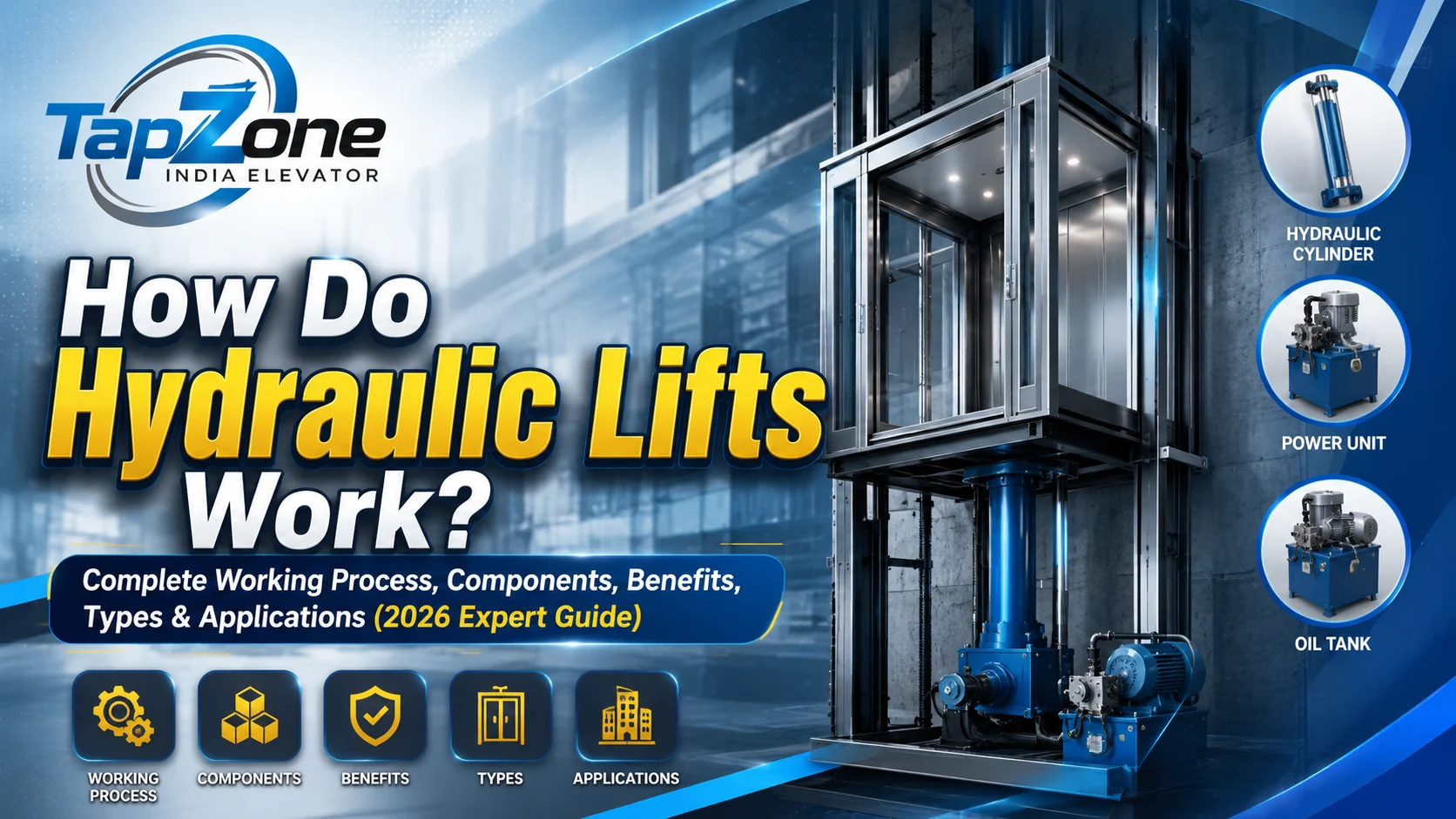
Introduction to Hydraulic Lifts
Hydraulic lifts have revolutionized the method of lifting of heavy goods, automobiles, and industrial material in contemporary buildings and factories. If you own warehouses, automobile workshops, manufacturing plants, hospitals, malls or any commercial building, knowing about how do hydraulic lifts work is important for selecting the appropriate lifting system. Here is an in-depth hydraulic lift guide that will tell you everything, right from the fundamental operating principles to industrial uses of hydraulic lifts.
In case you have ever asked what is hydraulic lift, here is your answer in this in-depth guide. From the operation of hydraulic lift to components, pros, safety features and uses in industries, this guide will help you learn about why hydraulic lift has become the most reliable lifting system in the world today. We at Tapzone India Elevator believe that the best choice in lifting system can be made after knowing about the technology of hydraulic lifts.
What is Hydraulic Lift? A Complete Introduction
Are you curious to know what hydraulic lift is? It is actually a type of lifting machine that functions on the principles of hydraulic pressure for lifting heavy loads vertically. It works by making use of hydraulic pressure in order to move the piston upwards using hydraulic oil inside the cylinder, unlike other lifts where the rope or gear and counterweight are used.
A more elaborate definition of hydraulic lift starts with the introduction of Pascal’s law. It is a scientific law that says that pressure exerted on a confined fluid will be transmitted equally in all directions. This is what every hydraulic lift works upon to raise cars, industrial equipment, cargoes, and people. Hydraulic pressure in hydraulic lifts increases the force multiplication without bulky mechanical parts.
Why Hydraulic Lifts Are Popular in Modern Industries
Modern industries need lifting mechanisms that are safe, efficient, and able to carry weight-bearing loads all the time. Hydraulic lifts provide much better results in this aspect in comparison with traditional lifting methods. These systems are easy to operate, do not require intensive maintenance procedures, and have high lifting capacities.
The need for hydraulic lifts has been constantly growing over the past years, as they can be used in different industries. Knowing what a hydraulic lift is useful for helps you to choose the right type of machinery for your business.
Why Hydraulic Lift Technology is Important in 2026
As modern industries get automated, the need for sophisticated lifting systems arises. Contemporary hydraulic lifts are equipped with intelligent control system, sophisticated safety sensors, efficient hydraulic pump and advanced materials, which make operations more effective. With changing trends in industries, today’s working of hydraulic lift is better than ever.
It becomes increasingly common for business enterprises to invest in quality hydraulic lift systems due to their smooth operations, stable lifting positions, reliable performance and long lifespan. In Tapzone India Elevator, all lifting systems are created keeping in mind all industrial needs and requirements.
Growing Demand Across Industries
Factory units, warehouse units, hospitals, hotels, shopping malls, vehicle service stations, and housing structures all need reliable lifting equipment. The correct hydraulic lift definition explains how the use of hydraulics continues to be one of the safest forms of lifting mechanisms available.
Knowledge on what is a hydraulic lift is essential before making any investment into the industrial machinery. It is through selecting the right capacity, size, hydraulic cylinders, and controls that one gets productivity and safety at work.
Basic Principle Behind Hydraulic Lift
Any hydraulic lift works through hydraulic pressure exerted by an incompressible fluid, such as hydraulic oil. In the process where pressure is created via the hydraulic pump, the oil moves through the piping into the hydraulic cylinder. The hydraulic pressure causes the movement of the piston upwards and lifts the lift platform effortlessly.
Hydraulic lift working is explained purely in terms of Pascal’s Principle. Because liquids cannot be easily compressed, the pressure exerted will act equally in all parts of the hydraulic system. In turn, relatively smaller forces can create huge lifting capacity. It means that the working of the hydraulic lift is extremely effective for moving heavy weights.
Why Pascal’s Law Matters
The absence of Pascal’s Law would result in the malfunction of hydraulic lifts. It makes pressure multiplication possible and helps lift machinery, automobiles, industrial tools, and materials through relatively smaller hydraulic pumps.
Knowledge of what is hydraulic lift requires comprehension of the fact that hydraulic systems offer great stability while lifting things. This is because the pressure in the hydraulic system stays constant during the entire process.
Major Advantages of Hydraulic Lifts
One of the main reasons why there is such a preference for hydraulic lifts by industries is that it has an excellent lifting capacity. It is able to lift very light, medium, and even heavy loads. In addition to that, the hydraulic lift is safer than many conventional lifting systems.
The other main reason is operational safety. The way in which the hydraulic lift operates makes sure that the lifting process is smooth and the speed is controlled.
Key Benefits Businesses Receive
Companies that know about hydraulic lifts always opt for hydraulic mechanisms owing to their extended lifetime and high reliability levels. Moreover, modern hydraulic systems need less maintenance time due to fewer moving mechanical parts than cable-operated mechanisms.
Our company, Tapzone India Elevator, provides the latest hydraulic lift technology solutions with a high level of durability, performance, and safety for industries, commercial purposes, and automotive purposes. All the projects are customized as per the customer’s needs, making sure that business owners get their lifting machinery working efficiently for years to come.
Major Benefits at a Glance
- High lifting capacity
- Smooth vertical movement
- Excellent load stability
- Reliable hydraulic pressure system
- Lower maintenance requirements
- Longer service life
- Better operational safety
- Energy-efficient operation
- Compact installation
- Suitable for indoor and outdoor applications
Industries Using Hydraulic Lift Technology
Today, hydraulic lifts are widely used across numerous industries because of their versatility and efficiency. Common sectors include:
- Automobile service stations
- Manufacturing industries
- Warehouses
- Logistics hubs
- Shopping malls
- Hospitals
- Hotels
- Airports
- Residential buildings
- Commercial complexes
- Industrial plants
- Distribution centers
Each of these industries benefits from the dependable working of hydraulic lift, allowing heavy goods, vehicles, machinery, and passengers to be transported safely between different levels.
Main Components of a Hydraulic Lift System
The functioning of a hydraulic lift can be made much simpler once one understands how each and every component works together. A contemporary hydraulic lift consists of many precisely engineered components that together make a single system. Each of these components is very important in making sure that the lift can function safely and effectively.
Any description of a hydraulic lift is incomplete without talking about these components. It will help a great deal in making an informed investment decision no matter where you plan on installing a lift whether in a warehouse, factory, showroom, auto repair shop, or a commercial building. All hydraulic lifts made at Tapzone India Elevator are equipped with the best components available.
Hydraulic Cylinder
The hydraulic cylinder is considered the heart of every hydraulic lift. It contains the piston that moves vertically when hydraulic oil enters the cylinder under pressure. The cylinder directly converts hydraulic energy into lifting force, making it one of the most important components in the entire system.
The size and quality of the hydraulic cylinder determine the lifting capacity, travel height, and overall efficiency of hydraulic lifts. Heavy-duty industrial cylinders are specially designed to withstand continuous operation under demanding conditions while ensuring smooth lifting performance.
Hydraulic Pump
The hydraulic pump is responsible for generating the pressure required for the working of hydraulic lift. It draws hydraulic oil from the reservoir and sends it through the hydraulic lines at high pressure. This pressurized oil pushes the piston upward, allowing the lift platform to rise smoothly.
Modern hydraulic lift systems use highly efficient electric motor-driven pumps that provide consistent pressure while reducing energy consumption. High-quality pumps also help minimize vibration and operational noise.
Hydraulic Oil Reservoir
The oil reservoir stores hydraulic fluid used throughout the lifting process. Clean hydraulic oil is essential because it transfers pressure, lubricates internal components, reduces friction, and prevents overheating.
A well-designed oil tank improves the overall efficiency of hydraulic lifts by maintaining the correct oil temperature and preventing contamination. Regular oil inspection is an important part of hydraulic system maintenance.
Control Valve
The control valve regulates the direction and flow of hydraulic oil inside the system. During lifting, lowering, and stopping operations, the valve precisely controls oil movement to maintain safe and stable operation.
This component plays a significant role in the working of hydraulic lift, ensuring smooth acceleration, accurate positioning, and controlled descent without sudden jerks.
Hydraulic Pipes and Hoses
Hydraulic pipes and flexible hoses carry pressurized oil between different components. These pipelines must withstand high pressure while preventing leakage.
Premium-quality hydraulic hoses increase the safety and efficiency of every hydraulic lift by maintaining constant oil flow even during continuous industrial operation.
Electric Motor
The electric motor powers the hydraulic pump. It converts electrical energy into mechanical energy, allowing the pump to generate hydraulic pressure.
Energy-efficient motors used in modern hydraulic lifts reduce electricity consumption while maintaining high lifting performance even under heavy-duty applications.
Lift Platform
The platform is the area where goods, machinery, vehicles, or passengers are placed. Its size, load capacity, and structural design depend upon the intended application.
Industrial platforms are manufactured using heavy-duty steel structures capable of supporting several tons of weight safely.
Safety Devices
Modern hydraulic lift systems include multiple safety mechanisms such as:
- Emergency stop switch
- Overload protection
- Pressure relief valve
- Safety lock
- Anti-fall mechanism
- Limit switches
- Emergency lowering system
- Electrical protection system
These safety features ensure reliable operation while protecting both operators and equipment.
Step-by-Step Working of Hydraulic Lift
Now that you understand what is hydraulic lift and its major components, let’s explore the complete working of hydraulic lift from start to finish. Every lifting cycle follows a carefully controlled hydraulic process that ensures maximum efficiency and operator safety.
Step 1 – Lift Receives the Command
The lifting process begins when the operator presses the control button. The electrical control panel sends a signal to the motor, initiating the lifting operation.
Within seconds, the electric motor starts rotating, preparing the hydraulic system to generate pressure.
Step 2 – Hydraulic Pump Starts Working
Once activated, the hydraulic pump draws hydraulic oil from the reservoir. The pump compresses the oil and builds hydraulic pressure inside the system.
This is one of the most important stages in the working of hydraulic lift because hydraulic pressure provides the lifting force.
Step 3 – Oil Travels Through Hydraulic Lines
The pressurized hydraulic oil moves through specially designed pipes and hoses toward the hydraulic cylinder.
Since hydraulic oil is nearly incompressible, pressure remains consistent throughout the system, ensuring efficient power transmission.
Step 4 – Hydraulic Cylinder Activates
As hydraulic oil enters the cylinder, pressure builds beneath the piston.
The piston begins moving upward with tremendous force, converting hydraulic pressure into mechanical lifting motion.
Step 5 – Lift Platform Starts Rising
The upward movement of the piston raises the lift platform gradually.
One of the biggest advantages of a hydraulic lift is its exceptionally smooth movement, even while lifting heavy industrial loads.
Step 6 – Stable Vertical Movement
Modern hydraulic lifts include advanced flow control valves that regulate oil movement continuously.
This ensures smooth lifting speed, eliminates sudden jerks, and keeps the platform perfectly stable throughout the journey.
Step 7 – Reaching the Desired Height
When the platform reaches the selected level, the control system automatically stops the hydraulic pump.
The hydraulic pressure remains locked inside the cylinder, allowing the platform to remain stable without continuous motor operation.
Step 8 – Lowering Process Begins
When the operator presses the down button, the control valve gradually releases hydraulic oil back into the reservoir.
As pressure decreases inside the cylinder, gravity assists the piston in returning to its original position.
Step 9 – Smooth Controlled Descent
Unlike mechanical lifting systems, the descent of hydraulic lifts is carefully controlled by hydraulic valves.
This prevents sudden drops and provides maximum safety for goods, machinery, and passengers.
Step 10 – Cycle Completes
Once the platform reaches ground level, hydraulic pressure returns to its normal operating state.
The lift is now ready for the next lifting cycle.
Hydraulic Lift Working Flow Chart
The complete hydraulic lift explanation can be summarized using the following sequence:
Operator Command
↓
Electric Motor Starts
↓
Hydraulic Pump Generates Pressure
↓
Hydraulic Oil Pressurizes
↓
Oil Enters Hydraulic Cylinder
↓
Piston Moves Upward
↓
Lift Platform Rises
↓
Required Height Achieved
↓
Control Valve Opens
↓
Oil Returns to Tank
↓
Platform Lowers Safely
↓
Cycle Complete
Factors That Affect Hydraulic Lift Performance
Several factors influence the performance and lifespan of a hydraulic lift.
Hydraulic Oil Quality
Clean hydraulic oil improves efficiency, reduces wear, and increases component life.
Load Capacity
Overloading affects the working of hydraulic lift, increasing pressure on the hydraulic cylinder and pump.
Maintenance
Regular servicing ensures smooth operation and prevents unexpected breakdowns.
Component Quality
Premium hydraulic components significantly improve lifting performance and system reliability.
Installation Quality
Proper installation ensures accurate alignment, better safety, and long-term durability.
At Tapzone India Elevator, every hydraulic lift is engineered with premium components, advanced hydraulic technology, and strict quality standards to deliver exceptional performance across industrial, commercial, and automotive applications.
Types of Hydraulic Lifts
Once the knowledge of hydraulic lift and its working is done, it becomes equally necessary to know about the various types of hydraulic lifts existing in the market. As different industries have their unique lifting demands, choosing the right kind of hydraulic lift will impact the safety, efficiency, and cost involved in operations. The modern hydraulic lifts are meant to cater to the specific load capacity, space for installation, and operating environment.
Apart from the working and structure of the hydraulic lifts, their purpose also plays an important role in explaining the same. We at Tapzone India Elevator manufacture custom-designed lifting solutions catering to the demands of industries, commercial organizations, and automobiles.
Goods Hydraulic Lift
A Goods Hydraulic Lift is specially designed for transporting heavy materials between different floors. These lifts are widely used in warehouses, factories, distribution centers, retail stores, and logistics hubs. The strong steel platform, heavy-duty hydraulic cylinder, and advanced control system allow the lift to move bulky loads smoothly and safely.
Car Hydraulic Lift
Car hydraulic lifts are commonly installed in automobile workshops, service stations, parking facilities, and residential buildings. They provide a safe and efficient solution for lifting vehicles for servicing, maintenance, or vertical parking. Their smooth lifting mechanism minimizes vibration, ensuring complete vehicle safety.
Passenger Hydraulic Lift
Passenger hydraulic lifts are designed to transport people comfortably between different floors. These lifts are ideal for hospitals, hotels, schools, offices, shopping malls, and residential buildings where low- to medium-rise vertical transportation is required.
Scissor Hydraulic Lift
A Scissor Hydraulic Lift uses a crisscross steel mechanism that expands vertically through hydraulic pressure. These lifts are widely used for maintenance work, warehouse operations, construction projects, and loading activities where temporary elevation is required.
Dock Hydraulic Lift
Dock lifts simplify loading and unloading operations by creating a level platform between trucks and warehouses. They improve material handling efficiency while reducing manual labor and loading time.
Freight Hydraulic Lift
Freight lifts are engineered for transporting heavy industrial equipment, machinery, pallets, and raw materials. Their reinforced platform and high-capacity hydraulic system make them ideal for demanding industrial applications.
Applications of Hydraulic Lifts
The increasing demand for hydraulic lifts is driven by their versatility and ability to perform efficiently across multiple industries. Businesses searching for what is hydraulic lift often discover that these systems are suitable for almost every environment where vertical transportation is required.
The working of hydraulic lift provides reliable lifting performance even under continuous industrial operations, making these systems one of the most trusted material-handling solutions available today.
Manufacturing Industries
Manufacturing plants use hydraulic lift systems for moving raw materials, finished products, heavy machinery, and production equipment safely between different working levels.
Warehouses
Warehouse operators depend on hydraulic lifts to improve inventory movement, reduce manual handling, and increase operational efficiency while maintaining workplace safety.
Automobile Workshops
Vehicle servicing requires safe and stable lifting equipment. Automotive workshops rely on hydraulic lift technology for inspection, repairs, wheel alignment, engine servicing, and underbody maintenance.
Hospitals
Hospitals use passenger hydraulic lifts and specialized bed lifts to transport patients comfortably and safely between departments while ensuring smooth and vibration-free movement.
Shopping Malls
Commercial buildings install hydraulic lifts to improve accessibility for visitors while transporting goods efficiently between storage areas and retail floors.
Hotels
Hotels utilize passenger lifts and service lifts to enhance guest convenience and streamline housekeeping operations.
Airports
Airports use heavy-duty hydraulic lifting equipment for cargo handling, baggage transportation, and aircraft maintenance support.
Residential Buildings
Modern homes increasingly install compact hydraulic lift systems to improve accessibility for elderly family members and individuals with mobility challenges.
Benefits of Hydraulic Lifts
Among many benefits, the most important factor for which a hydraulic lift is selected by an industry is the perfect blend of efficiency, longevity, and safety that it offers. The working of hydraulic lift provides a detailed insight into why a hydraulic system offers efficient lifting with reduced maintenance needs.
The operation of hydraulic lift has many benefits over traditional mechanical lifting systems.
High Load Carrying Capacity
Hydraulic technology allows heavy loads to be lifted with remarkable stability. Even under demanding operating conditions, hydraulic pressure remains consistent, ensuring reliable performance.
Smooth Operation
The controlled movement of hydraulic oil eliminates sudden jerks during lifting and lowering, providing a comfortable and secure lifting experience.
Low Maintenance
Because hydraulic lifts contain fewer moving mechanical parts than cable-driven systems, maintenance requirements are significantly lower.
Energy Efficient
Modern hydraulic pumps and electric motors consume less power while delivering excellent lifting performance.
Long Service Life
Premium hydraulic components ensure years of reliable operation with proper maintenance and regular inspections.
Safe Operation
Multiple safety mechanisms such as overload protection, pressure relief valves, emergency stop buttons, and safety locks provide maximum protection during operation.
Cost-Effective Solution
Lower maintenance costs, high durability, and dependable performance make hydraulic lifts an excellent long-term investment.
Maintenance Tips for Hydraulic Lifts
Maintenance is critical in ensuring that all hydraulic lifts have their lifespan prolonged. Routine checkups are beneficial in enhancing efficiency and avoiding any sudden breaks in the machinery.
Make sure you keep an eye on the hydraulic oil level and change the dirty oil according to the manufacturer’s specifications by the manufacturer. Oil cleanliness is crucial in ensuring efficient pressure flow through the machine and the performance of hydraulic lift.
Make sure that the hoses and other hydraulic pipes and fittings do not have any leaks since even the smallest leak can make the lift work poorly.
Lubricate the moving parts as per the guidelines provided and maintain the cylinder, pump, valves, and the electrical control parts of the hydraulic lift.
Always avoid overloading the lift above its capacity since more load will put extra pressure on the hydraulic system of the lift.
Safety Tips While Operating Hydraulic Lifts
Safe operation should always be the highest priority when using any hydraulic lift. Operators must receive proper training before handling lifting equipment.
Always verify the load weight before operation and ensure it does not exceed the rated lifting capacity.
Never allow unauthorized persons to operate the lift.
Keep the lifting platform free from unnecessary obstacles and ensure that the load is evenly distributed.
Inspect emergency stop buttons and safety devices before starting daily operations.
Disconnect the power supply before carrying out maintenance or repairs.
Follow all manufacturer safety instructions to ensure reliable and accident-free performance.
Why Choose Tapzone India Elevator?
We at Tapzone India Elevator are committed to designing and manufacturing high-quality hydraulic lifts for industries, commerce, warehouses, automobiles, and residences. All our hydraulic lifts are designed by employing best-in-class materials, hydraulic techniques, and stringent quality control measures to provide unmatched durability and longevity.
If you are searching for any type of lift, be it a goods lift, car lift, freight lift, passenger lift, or a tailor-made lift solution, our skilled engineering team offers complete assistance for design, manufacturing, installation, and post-sales services. Our dedication to innovation, safety, and customer satisfaction has earned us a reputable position in the lifting sector.
Conclusion
An insight into what hydraulic lift is and how the system of the hydraulic lift works is important for the business so that it can choose the best lifting system for its needs. From lifting heavy materials in industries to lifting passengers and servicing automobiles, hydraulic lifts always stand out in terms of performance, safety, and efficiency.
This extensive explanation of hydraulic lifts explains how hydraulic lifts use the power of fluid pressure in combination with precise engineering to build powerful, durable, and efficient lifting systems. Buying a good-quality hydraulic lift from Tapzone India Elevator will help businesses increase efficiency and safety and decrease maintenance costs.