Installing a lift (home elevator) is no longer limited to large villas. Today, many people in India are installing lifts in their two- or three-story homes. This makes daily movement easier, provides convenience for elderly family members, and serves as a valuable, long-term addition to the home.
If you are considering installing a lift in a three-story house, the first question that arises is: how much will it cost? The answer varies from home to home. The total expense depends on several factors, such as the lift technology, the number of floors served, load capacity, cabin size, type of doors, interior design, shaft construction, installation requirements, and safety features.
For a three-story home (ground floor plus two additional floors) in India, buyers can choose from various options based on their budget. Basic, locally manufactured systems may be available at a lower price point, while premium options—such as hydraulic, gearless, or screw-driven lifts, glass-enclosed models, or imported units—can be significantly more expensive.
This guide explores the costs associated with installing a lift in a three-story home in India. It covers essential features, factors that influence pricing, installation requirements, maintenance costs, and key considerations to keep in mind before selecting a lift.
How Much Does an Elevator Cost for a 3-Story House?
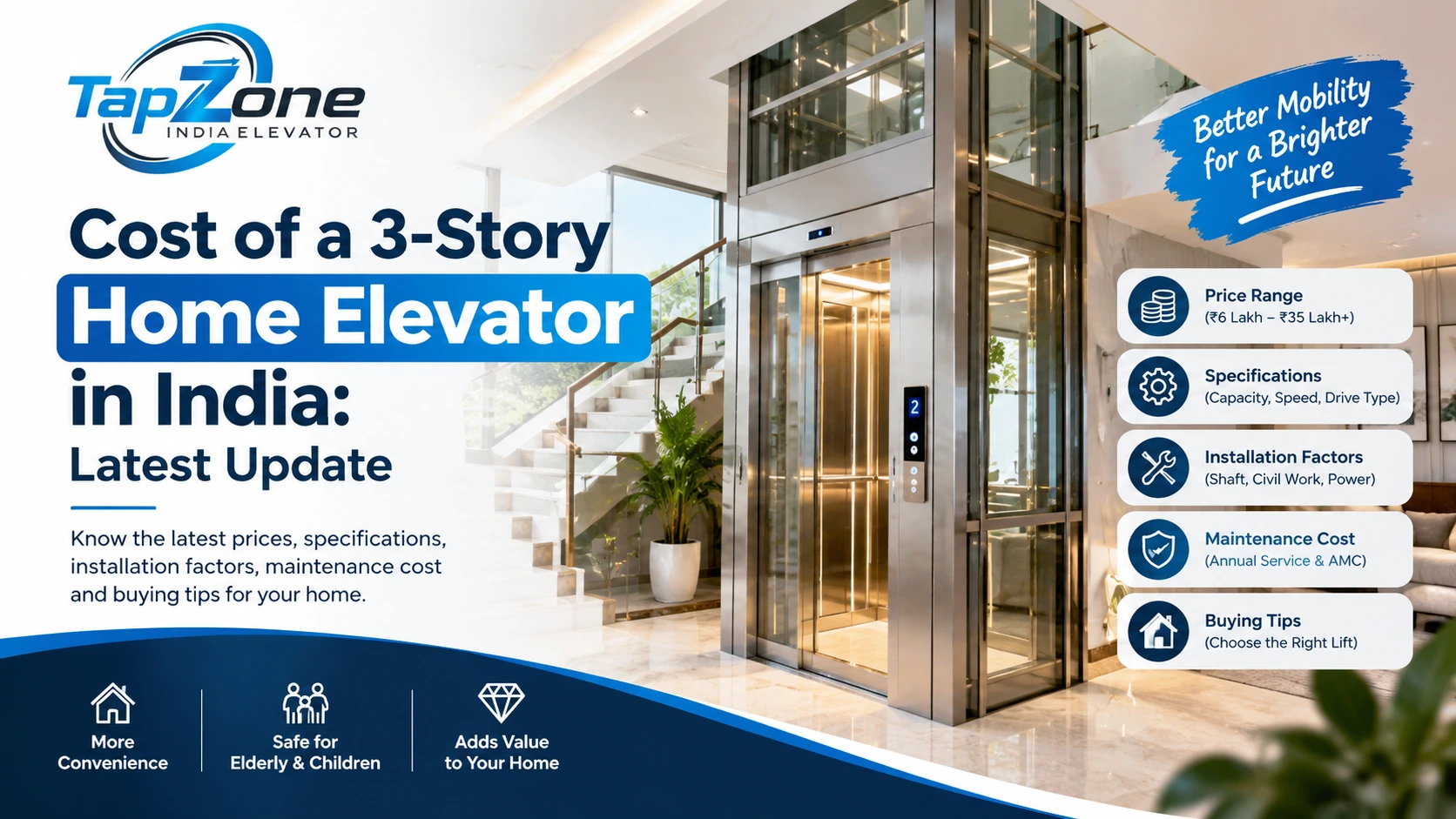
So, How much does an elevator cost? For a 3-story residential property, there is no single fixed market price.
In the Indian market, a standard residential elevator may fall roughly between ₹6 lakh and ₹20 lakh or more, depending on its technology, capacity, design, and installation requirements. Premium residential elevator systems can move well beyond this range.
For example, a basic locally manufactured elevator with standard finishes may be available at the lower end of the budget. On the other hand, a premium gearless, hydraulic, screw-driven, pneumatic, or designer glass home elevator can cost ₹20 lakh, ₹30 lakh, or even more.
Therefore, homeowners should never select an elevator simply because its starting price looks attractive. The complete project cost matters more than the basic machine price.
Approximate 3-Story Home Elevator Price Range
| Elevator Category | Approximate Price Range |
|---|---|
| Basic Residential Lift | ₹6 lakh – ₹10 lakh |
| Standard Home Elevator | ₹8 lakh – ₹15 lakh |
| Hydraulic Home Elevator | ₹10 lakh – ₹20 lakh+ |
| Gearless / MRL Elevator | ₹10 lakh – ₹25 lakh+ |
| Screw-Driven Home Lift | ₹14 lakh – ₹30 lakh+ |
| Premium / Customized Lift | ₹20 lakh – ₹35 lakh+ |
These figures should be treated as general planning estimates rather than fixed quotations. Civil work, GST, shaft construction, premium interiors, transportation, electrical work and special customization may be charged separately.
Understanding the Price of Lift Machine Family Use
Many buyers search online for terms such as reported price of lift machine family while trying to understand how much a residential lift may cost.
The important point is that the reported price of lift machine family use cannot be judged only from the cost of the motor or lifting machine. A complete home elevator contains several major components, including the drive system, controller, cabin, landing doors, guide rails, safety equipment, electrical system and operating panel.
Installation and site preparation also contribute to the final budget.
A very low machine-only quotation may therefore look economical initially, but it does not necessarily represent the complete cost of a working home elevator.
When comparing quotations, ask whether the quoted amount includes:
- Elevator machine and drive system
- Cabin and cabin frame
- Controller
- Landing doors
- Guide rails
- Operating panels
- Safety equipment
- Installation
- Testing and commissioning
- Transportation
- Electrical work
- Civil work
- GST
- Warranty
- Maintenance support
This gives you a much clearer understanding of the actual project cost.
Price Thang Machine Home 3 Storey: What Does It Mean for Buyers?
Some homeowners use search phrases such as price thang machine home 3 storey or thang machine home 3 storey when looking for the price of a lift machine suitable for a three-floor property.
If you are searching for price thang machine home 3 storey, focus on the complete elevator rather than just one machine component.
A three-story elevator usually needs three stops—for example:
Ground Floor → First Floor → Second Floor
The elevator must have suitable travel height, guide rails, landing doors, controls and safety arrangements for all three levels.
Therefore, the price thang machine home 3 storey depends on much more than the motor. The same machine may be combined with different cabin sizes, door systems, controllers and finishes, resulting in very different project costs.
Similarly, when comparing a thang machine home 3 storey solution, check its rated load, drive technology, power requirements, warranty and availability of spare parts.
What Affects the Cost of a 3-Story Home Elevator?
If you are asking How much does an elevator cost?, understanding the major price factors will help you prepare a realistic budget.
1. Elevator Technology
Technology is one of the biggest cost factors. Residential properties may use hydraulic, traction, gearless MRL, screw-driven or pneumatic systems.
Each technology has different space, structural, power and maintenance requirements.
2. Load Capacity
A small 2-person lift generally costs less than a larger elevator designed for 4–6 passengers.
Common residential capacities may include approximately:
250 kg, 300 kg, 320 kg, 400 kg and above.
The correct capacity should be selected according to expected family use rather than price alone.
3. Number of Stops
A three-story property normally requires three stops. Each additional stop can require another landing door, additional guide rails, wiring, sensors and installation work.
This is why a three-stop home elevator normally costs more than the same model configured for only two stops.
4. Cabin Size
Larger cabins require more material and usually need a larger shaft. If wheelchair access is required, the dimensions must be planned carefully during the design stage.
5. Door Type
Manual swing doors can be less expensive than fully automatic sliding doors.
Automatic doors provide better convenience, but they add components such as operators, sensors and controls, which can increase the overall cost.
6. Cabin Interior
A simple stainless-steel cabin will normally cost less than a customized luxury cabin.
Popular upgrades include:
- Designer stainless steel
- Glass panels
- Wooden-finish panels
- Decorative ceiling
- Premium flooring
- Mirrors
- LED lighting
- Custom control panels
These features can make a home elevator look more attractive, but they also affect the final quotation.
Typical Specifications for a 3-Story Home Elevator
Before comparing the reported price of lift machine family solutions, compare the technical specifications as well.
A typical residential elevator may have specifications similar to the following:
| Specification | Typical Option |
|---|---|
| Application | Residential / Home |
| Number of Stops | 3 Stops |
| Suitable Building | G+2 / Three Story |
| Capacity | Approx. 250–400 kg |
| Passenger Capacity | Approx. 2–5 Persons |
| Drive Type | Hydraulic / Traction / Gearless / Screw |
| Speed | Approx. 0.3–1.0 m/s depending on system |
| Door Type | Manual or Automatic |
| Cabin Finish | SS / Glass / Customized Finish |
| Control | Automatic / Microprocessor Based |
| Emergency Feature | Alarm / Emergency Lowering as applicable |
| Power Supply | Model dependent |
| Machine Room | Required or MRL depending on technology |
| Pit Requirement | Depends on lift model and design |
| Number of Entrances | As per site requirement |
| Lighting | LED Cabin Lighting |
| Installation | Indoor / Suitable External Structure |
| Usage | Family / Residential Movement |
These are indicative specifications. Final dimensions, capacity, pit depth, headroom, power supply and structural requirements should always be confirmed from the approved technical drawing for the selected elevator.
Hydraulic vs Gearless Home Elevator
The type of home elevator you choose has a major effect on both installation and price.
Hydraulic Elevator
A hydraulic lift uses a hydraulic system to move the elevator cabin. It is commonly considered for low-rise residential applications.
Its benefits can include smooth movement, simple low-rise operation and flexibility for certain residential layouts. However, the installation design, hydraulic power unit, maintenance needs and space requirements should be checked before finalizing it.
Gearless or MRL Elevator
MRL means Machine Room Less. In many designs, a separate conventional machine room is not required.
Gearless MRL systems can provide smooth travel, efficient use of building space and a modern residential solution. Depending on the model and specification, the initial investment may be higher than a very basic lift system.
When deciding between the two, do not ask only How much does an elevator cost? Also compare space, power, maintenance, ride quality and long-term service support.
Hidden Costs You Should Know Before Installation
When researching price thang machine home 3 storey, many buyers focus only on the equipment quotation. This can lead to unexpected expenses later.
Your total project budget may also include shaft construction, pit work, structural modifications, electrical supply, finishing work, transport, taxes and annual maintenance.
For an existing house, installation can sometimes require more structural work because the property was not originally designed with a lift shaft.
A new home gives architects and lift engineers more flexibility to plan the shaft, pit, door openings and electrical requirements from the beginning.
Before placing an order, ask the supplier for an itemized quotation so that you clearly understand what is included and what is excluded.
Can a Home Elevator Be Installed in an Existing 3-Story House?
Yes. A home elevator can often be installed in an existing three-story house, provided the building has a suitable location and the structure can safely accommodate the selected system.
Possible locations may include:
- Staircase void
- Side of the staircase
- Indoor open area
- Courtyard
- External wall
- Purpose-built steel structure
Compact lift technologies can be useful where traditional shaft space is limited.
However, structural changes should never be decided only by the elevator supplier. If slabs, beams or major walls need modification, the work should be reviewed by a qualified structural professional.
Safety Features to Check in a Home Elevator
Whether you are comparing thang machine home 3 storey options or premium residential elevators, safety should remain a priority.
Look for appropriate features such as an emergency alarm, door interlocks, emergency lighting, overload protection, automatic rescue or emergency lowering where applicable, limit switches, braking systems and suitable backup arrangements.
The exact safety equipment depends on the lift technology and applicable requirements.
A lower reported price of lift machine family should never be preferred if important safety systems, installation quality or after-sales service have been compromised.
Maintenance Cost of a 3-Story Home Elevator
The buying price is only one part of ownership.
A home elevator needs regular inspection and maintenance to keep its doors, drive system, controls, sensors and safety components working properly.
Depending on the elevator type, brand, location and service coverage, annual maintenance can range from roughly ₹10,000 to ₹40,000 or more. Premium or imported systems and comprehensive maintenance packages can cost more.
Before purchasing, ask:
- What is included in the warranty?
- How long is free service available?
- What will the AMC cost after warranty?
- Are spare parts easily available?
- How quickly can technicians reach your location?
- Are replacement parts covered under AMC?
A slightly higher initial investment with reliable service support can sometimes provide better long-term value.
How to Choose the Right 3-Story Home Elevator
Do not select a lift only because the price thang machine home 3 storey appears low.
Start by understanding your family’s actual needs.
For example, if the elevator will mainly be used by elderly family members, ease of entry, reliable doors, smooth movement and emergency support may be more important than decorative features.
If wheelchair movement is required, cabin and door dimensions become extremely important.
If the house has limited space, a compact system may be more practical than a conventional elevator that requires extensive civil work.
You should compare at least the following before making a decision:
- Total installed price
- Elevator technology
- Rated capacity
- Cabin dimensions
- Number of stops
- Door type
- Shaft requirement
- Pit and headroom requirement
- Power consumption
- Safety equipment
- Warranty
- AMC charges
- Spare-part availability
- Installation timeline
- After-sales support
Why Consider Tapzone India Elevator?
When planning a residential elevator, homeowners need more than a machine—they need a solution that fits their building, usage and available space.
Tapzone India Elevator can be considered by homeowners looking for residential elevator solutions for multi-story properties. The right approach starts with understanding the building layout, required capacity, number of stops, preferred cabin design and available installation space.
Instead of focusing only on How much does an elevator cost?, homeowners should request a complete project quotation based on their actual site.
This makes it easier to compare the equipment, installation requirements, specifications and long-term maintenance costs before making a final investment.
Is a 3-Story Home Elevator Worth the Cost?
For many families, yes.
A properly selected home elevator can make movement between floors much easier, especially in homes with senior citizens, people with limited mobility, children or family members who find regular stair use difficult.
It can also make carrying luggage, groceries and household items between floors more convenient.
The real value of an elevator should therefore not be measured only through the reported price of lift machine family. Daily convenience, accessibility, long-term usability, maintenance and service support are equally important.
Final Words
So, How much does an elevator cost?
For a three-story house in India, the answer depends heavily on what you choose. A basic residential elevator may fit within a relatively moderate budget, while a premium customized home elevator with automatic doors, designer interiors, advanced drive technology and glass finishes can cost significantly more.
If you are searching for thang machine home 3 storey, price thang machine home 3 storey, or reported price of lift machine family, remember that the machine price alone does not tell you the complete cost.
Consider the elevator equipment, cabin, doors, controls, safety systems, shaft, civil work, electrical work, installation, taxes and future maintenance together.
For homeowners planning a G+2 residential lift, Tapzone India Elevator can help provide a suitable solution based on building layout, capacity, design preference and installation requirements.
The best elevator is not simply the cheapest one. It is the one that provides the right combination of safety, comfortable travel, suitable capacity, practical installation and dependable long-term performance.
Frequently Asked Questions
1. How much does an elevator cost for a 3-story home in India?
The cost can vary widely. Depending on technology and specifications, residential elevator projects may range from around ₹6 lakh to ₹20 lakh or more, while premium systems can cost ₹30 lakh or higher. Always request a site-specific quotation.
2. What is the best home elevator for a three-story house?
Hydraulic, gearless MRL, traction and screw-driven lifts can all be suitable. The best option depends on available space, capacity, budget, structural conditions and expected daily usage.
3. What affects the price thang machine home 3 storey?
The price thang machine home 3 storey can be affected by drive technology, capacity, travel height, number of stops, cabin size, doors, controller, safety equipment, finishes and installation conditions.
4. Can I install a home elevator without a machine room?
Yes. Certain gearless MRL, screw-driven and other compact residential elevator technologies can work without a traditional separate machine room. Requirements vary by model.
5. How many people can use a residential elevator?
Small residential lifts commonly accommodate approximately 2–5 people, depending on their rated load and cabin dimensions. Always follow the rated capacity specified by the manufacturer.
6. Is a home elevator expensive to maintain?
Maintenance depends on the technology and service package. Standard annual servicing may cost several thousand rupees, while comprehensive maintenance for premium systems can be significantly higher.
7. What should I check before buying a thang machine home 3 storey?
When comparing a thang machine home 3 storey, check capacity, technology, number of stops, power requirements, safety equipment, cabin size, warranty, spare parts and service support rather than comparing only the machine price.
8. Is a home elevator useful for senior citizens?
Yes. A properly designed residential elevator can significantly reduce dependence on stairs and make movement between different floors easier for elderly family members and people with mobility limitations.
9. Does a three-story home elevator need a pit?
It depends on the technology. Some conventional systems need a pit, while certain compact residential systems can work with a very shallow pit or different structural arrangement. Always check the approved installation drawing.
10. What is included in the reported price of lift machine family?
The reported price of lift machine family can refer to different scopes depending on the seller. Some quotations may cover only major equipment, while others include the cabin, doors, controls, installation and commissioning. Always request an itemized quotation to know exactly what you are paying for.