In commercial and industrial buildings, selecting the right lift is crucial for the safe and efficient movement of goods. That is why Tapzone India Elevator offers India’s best freight lifts—designed specifically for heavy loads—alongside service lifts, which are used to transport staff, supplies, equipment, and operational materials. Understanding the distinction between the two helps building owners choose a system that aligns with their daily operational needs.
Terms like “freight lift,” “service lift,” and “goods elevator” are often used interchangeably, leading to confusion. Common questions arise regarding what a freight lift is, its weight-bearing capacity, and whether it can transport people. This comprehensive guide explains the definition, working mechanism, types, features, load capacity, applications, and safety requirements of freight lifts, as well as the key differences between service lifts and freight lifts.
What Is a Service Elevator?
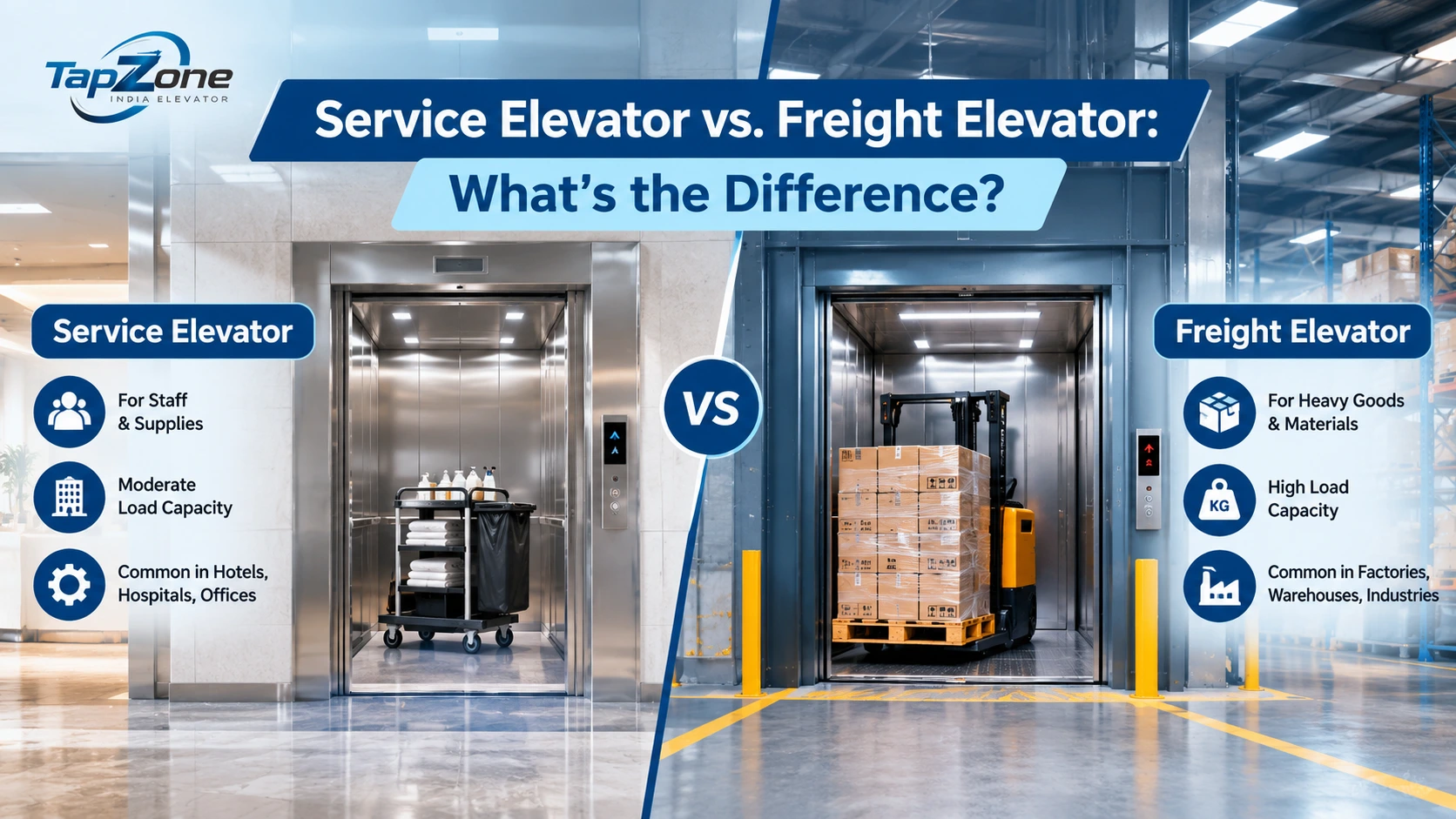
A service elevator is an elevator primarily used to support the daily operations of a building. It can transport maintenance staff, housekeeping personnel, supplies, equipment, food carts, laundry, and other service-related materials between floors.
Service elevators are commonly installed in:
- Hotels
- Hospitals
- Shopping malls
- Office buildings
- Residential complexes
- Restaurants
- Large commercial properties
Depending on the building design and safety requirements, a service elevator may be designed for both authorized personnel and service materials. The main purpose is to keep operational movement separate from passenger traffic.
A service elevator is generally selected when the building requires regular movement of moderate loads rather than extremely heavy industrial materials.
What Is a Freight Elevator?
To clearly understand the difference, it is important to answer the question: what is a freight elevator?
A freight elevator is a heavy-duty lifting system specifically designed to transport goods, machinery, equipment, pallets, industrial materials, and other heavy loads between different floors. It is built with stronger structural components than a standard passenger elevator.
The simple freight elevator meaning is an elevator designed primarily for carrying goods and materials rather than regular passenger transportation. A freight lift can be installed in factories, warehouses, manufacturing units, distribution centers, automobile facilities, and commercial buildings.
A properly designed freight elevator helps businesses move heavy materials safely and efficiently. The freight lift can reduce manual handling, improve workflow, and support faster material movement across multiple levels.
Note: The keyword “frieght elevator” is commonly searched online as a spelling variation of freight elevator, but the correct spelling is “freight elevator.”
Service Elevator vs. Freight Elevator: Quick Comparison
| Feature | Service Elevator | Freight Elevator |
|---|---|---|
| Primary Purpose | Service operations and supplies | Heavy goods and material transportation |
| Load Capacity | Moderate | Medium to very high |
| Main Users | Authorized staff and service personnel | Goods, materials and authorized operators |
| Cabin Design | Designed for operational use | Heavy-duty and impact-resistant |
| Door Type | Standard or commercial elevator doors | Heavy-duty manual or automatic doors |
| Flooring | Standard commercial flooring | Reinforced heavy-duty flooring |
| Applications | Hotels, hospitals and offices | Factories, warehouses and industries |
| Material Handling | Light to moderate | Heavy and bulky |
| Structural Strength | Moderate | High |
| Customization | Based on building requirements | Based on load and industrial requirements |
The biggest difference is the purpose. A service elevator supports building operations, while a freight elevator is specially engineered for material handling and heavy-duty transportation.
Service Elevator vs. Freight Elevator: The Main Differences
1. Purpose of Use
A service elevator is mainly used to support internal building operations. For example, hotel staff may use it to transport laundry, cleaning equipment, food supplies, and service carts.
A freight elevator, on the other hand, is designed specifically for moving goods and heavy materials. A manufacturing company may use a freight lift to transport raw materials, finished products, machinery components, or loaded pallets.
Therefore, when comparing both systems, the first question should be: What type of material needs to be moved?
2. Load Capacity
Load capacity is one of the most important differences between a service elevator and a freight elevator.
A service elevator is generally suitable for moderate loads required during daily building operations. A freight elevator is engineered to handle heavier loads and can be customized according to industrial requirements.
Typical freight lift capacities may vary significantly depending on the application.
| Application | Typical Capacity Requirement |
|---|---|
| Light Commercial Materials | 500–1,000 kg |
| Service and Supply Movement | 1,000–1,500 kg |
| Warehouse Materials | 1,500–3,000 kg |
| Industrial Goods | 3,000–5,000 kg |
| Heavy Machinery | 5,000 kg and above |
The actual capacity of a freight elevator depends on the building structure, shaft size, lifting mechanism, platform dimensions, and material handling requirements.
3. Cabin Construction
A standard service elevator may have a commercial-grade cabin suitable for regular operational movement.
A freight elevator usually requires stronger cabin construction because it handles pallets, trolleys, machinery, and bulky goods. Heavy-duty wall panels and reinforced flooring help protect the elevator from damage.
Important construction features of a freight elevator may include:
- Reinforced cabin structure
- Heavy-duty flooring
- Impact-resistant walls
- Strong door systems
- Durable guide rails
- High-capacity lifting mechanism
- Industrial control systems
The design of a freight lift focuses more on durability and load handling than decorative appearance.
4. Door Design
Door design plays a major role in material movement.
Service elevators may use standard automatic doors suitable for staff and operational activities. However, a freight elevator may require wider and stronger doors to allow easy movement of large goods.
Depending on the application, a freight elevator can use:
- Automatic sliding doors
- Telescopic doors
- Center-opening doors
- Heavy-duty manual doors
- Vertical lifting doors
The door opening should always match the size of the materials being transported through the freight lift.
What Is a Freight Elevator Used For?
People often ask, what is a freight elevator used for? The answer depends on the industry and building requirement.
A freight elevator is commonly used for transporting:
- Raw materials
- Finished products
- Pallets
- Industrial equipment
- Machinery parts
- Heavy boxes
- Manufacturing tools
- Warehouse goods
- Automobile components
- Construction materials
The main purpose of a freight lift is to move materials vertically without depending entirely on manual labor.
How Does a Freight Elevator Work?
Understanding the working process makes the freight elevator meaning even clearer.
A freight elevator works through a lifting system that moves the elevator cabin or platform vertically along guide rails. The system is controlled through an electrical control panel and safety mechanisms.
Basic Working Process
Step 1: Loading
Materials are placed inside the freight elevator cabin or on the lifting platform.
Step 2: Door Safety Check
The system checks whether the doors are properly closed and locked.
Step 3: Control Activation
The operator selects the required floor.
Step 4: Vertical Movement
The lifting mechanism moves the freight lift safely to the selected level.
Step 5: Floor Stopping
The elevator stops accurately at the required landing.
Step 6: Unloading
The materials are safely removed before the next operation.
Modern freight elevator systems may include advanced sensors, overload protection, emergency stopping, interlocks, and automatic controls.
Types of Freight Elevators
Different industries require different types of material handling systems. Therefore, a freight elevator can be customized according to load capacity, building height, and operational needs.
Hydraulic Freight Elevator
A hydraulic freight elevator uses hydraulic power for vertical movement. It can be suitable for certain low-rise and heavy-load applications.
Benefits
- High load-handling capability
- Smooth operation
- Suitable for specific heavy-duty requirements
- Effective for lower travel heights
A hydraulic freight lift should be selected after considering travel distance, operating frequency, and installation requirements.
Traction Freight Elevator
A traction freight elevator uses ropes, sheaves, and a counterweight-based lifting system.
It can be suitable for buildings requiring greater travel heights and regular vertical movement.
Benefits
- Suitable for multi-floor buildings
- Efficient for higher travel distances
- Can support regular operation
- Suitable for commercial and industrial applications
Industrial Freight Elevator
An industrial freight elevator is specially designed for factories, manufacturing plants, and heavy-duty facilities.
These systems may transport machinery, production materials, tools, and finished products.
The freight elevator meaning in an industrial environment is simple: it acts as an important vertical transportation system for business materials.
Warehouse Freight Lift
Warehouses often need to move pallets and goods between storage levels. A warehouse freight lift can help improve material flow and reduce unnecessary manual handling.
A properly designed freight elevator should consider:
- Pallet dimensions
- Maximum load weight
- Number of trips per day
- Loading method
- Forklift or trolley movement
- Available installation space
Important Features of a Freight Elevator
A high-quality freight elevator should not be selected only based on price. Its performance and safety features are equally important.
Important features may include:
Heavy-Duty Construction
The freight lift should be designed to handle the expected material weight and daily operational conditions.
Overload Protection
Overload protection helps prevent operation when the load exceeds the permitted capacity.
Door Interlocking
The elevator should not operate unless the doors are properly secured.
Emergency Stop System
An emergency stop allows the system to be stopped during an abnormal situation.
Accurate Floor Leveling
Proper leveling helps trolleys and materials move safely between the floor and the elevator.
Strong Flooring
The flooring of a freight elevator should withstand the weight and movement of loaded materials.
Benefits of Using a Freight Elevator
Installing a freight elevator can provide several operational benefits.
Faster Material Movement
A freight lift allows materials to move between floors faster than manual transportation.
Improved Workplace Efficiency
Employees can spend less time carrying materials and more time on productive work.
Reduced Manual Handling
Heavy goods can create safety risks when moved manually. A properly selected freight elevator can reduce unnecessary physical handling.
Better Material Protection
Controlled vertical transportation can reduce the chances of goods being dropped or damaged.
Higher Productivity
Regular and efficient movement of materials helps improve the overall workflow.
For industries with multi-floor operations, a freight elevator can become an essential part of the material handling system.
Where Are Service Elevators and Freight Elevators Used?
Service Elevator Applications
Service elevators are commonly used in:
- Hotels
- Hospitals
- Restaurants
- Office buildings
- Shopping centers
- Residential towers
- Educational institutions
Freight Elevator Applications
A freight elevator is commonly installed in:
- Manufacturing plants
- Warehouses
- Logistics centers
- Automobile facilities
- Industrial buildings
- Distribution centers
- Storage facilities
- Commercial production units
A heavy-duty freight lift can be designed according to the specific workflow of the facility.
Real-Life Example: Service Elevator vs. Freight Elevator
Imagine a large hotel with multiple floors.
The hotel may use a service elevator to transport:
- Food supplies
- Laundry
- Cleaning equipment
- Housekeeping carts
- Hotel staff
Now consider a manufacturing factory producing heavy equipment.
The factory may need a freight elevator to move:
- Metal components
- Production materials
- Heavy machinery parts
- Loaded pallets
- Finished products
This example clearly explains the difference. The service elevator supports operations, while the freight elevator is focused on heavy material transportation.
Freight Elevator Technical Specifications
The technical specifications of a freight elevator can vary according to the project.
| Specification | Details |
|---|---|
| Load Capacity | Customized according to application |
| Travel Height | Based on building floors |
| Cabin Size | Customized for material dimensions |
| Door Type | Manual or automatic |
| Drive System | Hydraulic or traction |
| Control System | Manual, semi-automatic or automatic |
| Flooring | Heavy-duty reinforced flooring |
| Safety System | Overload protection and emergency systems |
| Application | Industrial, warehouse or commercial |
| Power Requirement | Depends on capacity and drive system |
Before purchasing a freight lift, technical specifications should be finalized based on the actual material and operational requirements.
How to Choose the Right Freight Elevator
Selecting the right freight elevator requires more than simply choosing the highest load capacity.
1. Calculate Maximum Load
Identify the maximum weight that the freight lift will carry during normal operations.
Always consider the weight of:
- Goods
- Pallets
- Trolleys
- Containers
- Loading equipment
2. Measure Material Dimensions
The cabin size should be suitable for the largest material being transported.
A large load may not fit safely even if the freight elevator has enough weight capacity.
3. Consider Travel Height
The number of floors and total travel distance will influence the selection of the lifting system.
4. Check Usage Frequency
A freight elevator used 10 times per day may have different requirements from a system used hundreds of times per day.
High-frequency applications require reliable components designed for regular operation.
5. Consider Future Requirements
Businesses grow, and material handling requirements can increase. When possible, future operational needs should be considered before finalizing the freight lift.
Important Freight Elevator Safety Information
Safety should always be a priority when operating a freight elevator.
Important safety practices include:
- Never exceed the rated load capacity.
- Distribute materials properly.
- Keep hands away from moving components.
- Ensure doors are fully closed.
- Do not use a damaged elevator.
- Perform regular inspections.
- Train authorized operators.
- Avoid unstable loading.
- Follow recommended maintenance schedules.
- Keep the elevator area clean and obstruction-free.
The freight elevator should also be inspected and maintained according to applicable local regulations and project requirements.
Can Passengers Ride in a Freight Elevator?
This depends on the elevator design, applicable safety requirements, and local regulations.
A freight elevator is primarily designed for transporting materials. Whether authorized personnel can accompany the load depends on the specific system design and safety provisions.
Never assume that every freight lift is designed for passenger transportation. Always follow the manufacturer’s instructions and applicable safety requirements.
Service Elevator or Freight Elevator: Which One Should You Choose?
Choose a service elevator if your primary requirement involves:
- Daily building operations
- Staff movement
- Food and supply movement
- Laundry transportation
- Moderate operational loads
Choose a freight elevator if your primary requirement involves:
- Heavy goods
- Industrial materials
- Pallets
- Machinery
- Warehouse products
- Regular material transportation
The correct decision depends on your load capacity, material size, building structure, travel height, and usage frequency.
Why Professional Elevator Planning Is Important
Installing a lifting system without proper planning can create operational problems later. A freight elevator should be designed after understanding the actual working environment.
Important planning factors include:
- Maximum load capacity
- Cabin dimensions
- Door opening size
- Shaft dimensions
- Number of floors
- Travel height
- Operating frequency
- Material type
- Safety requirements
Professional planning helps ensure that the freight lift matches the real requirements of the facility instead of creating unnecessary limitations.
Frequently Asked Questions About Freight Elevators
What is a freight elevator?
A freight elevator is a heavy-duty elevator designed primarily for transporting goods, materials, equipment, pallets, and other heavy loads between different floors.
What is the freight elevator meaning?
The freight elevator meaning refers to an elevator system designed for vertical transportation of goods and materials rather than regular passenger movement.
What is a freight lift?
A freight lift is a lifting system used to move goods and heavy materials vertically between different levels. The term is often used in relation to industrial and commercial material handling systems.
What is the difference between a freight elevator and a service elevator?
A service elevator is mainly used for building operations, supplies, and authorized personnel, while a freight elevator is primarily designed for transporting heavy goods and industrial materials.
How much weight can a freight elevator carry?
The capacity of a freight elevator varies according to its design. Systems can be manufactured for light, medium, and heavy-duty applications depending on the project requirement.
Can a freight elevator carry machinery?
Yes, a properly designed freight elevator can transport machinery and heavy equipment. The load capacity, cabin dimensions, flooring, and structural design must be suitable for the machinery.
Is “frieght elevator” the correct spelling?
No. “Frieght elevator” is a commonly searched spelling variation. The correct spelling is “freight elevator.” However, users searching for frieght elevator are generally looking for information about a freight elevator or freight lift.
How do I select the right freight lift?
To select the right freight lift, consider the maximum load, material dimensions, travel height, number of floors, usage frequency, available space, and safety requirements.
Conclusion: Understanding the Difference Helps You Choose the Right System
A service elevator and a freight elevator may both transport materials between floors, but their purpose and construction can be very different. A service elevator is generally focused on supporting the daily operations of hotels, hospitals, offices, and commercial buildings. A freight elevator, however, is designed for stronger and heavier material handling requirements.
Understanding what is a freight elevator, the correct freight elevator meaning, available load capacities, technical specifications, safety features, and working requirements can help you make a better decision. Whether you need a heavy-duty freight lift for a warehouse or a customized solution for an industrial facility, the system should always be selected according to actual operational needs.
For businesses looking for reliable elevator and lifting solutions, Tapzone India Elevator can help in understanding project requirements and selecting a suitable system based on load, travel height, application, and safety needs. The right elevator is not simply about moving materials—it is about creating a safer, smoother, and more efficient workflow.